
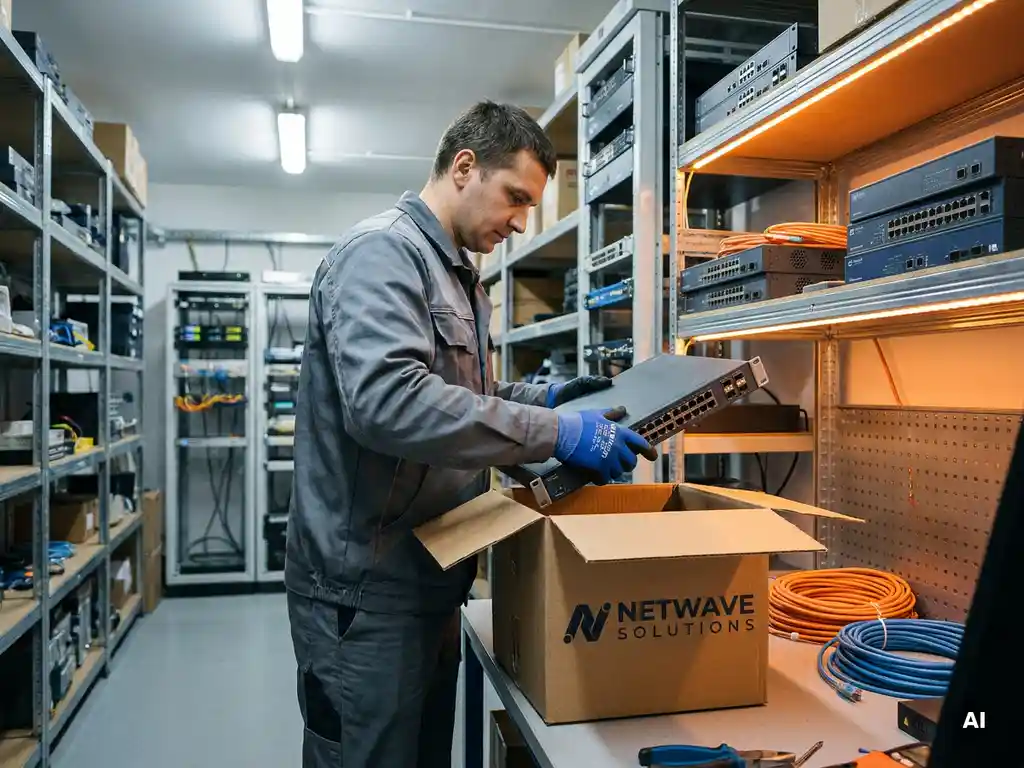
Telecom equipment manufacturers need fulfilment services that go well beyond standard warehousing and parcel dispatch. They require serialised inventory management, device configuration capabilities, structured returns processing, and a partner who understands the technical complexity of telecommunications hardware. Because telecom products often carry unique identifiers, require pre-deployment preparation, and operate within tightly managed supply chains, generic fulfilment solutions rarely meet the mark. The sections below address the most important questions telecom hardware manufacturers face when evaluating their logistics requirements.
What logistics challenges are unique to telecom equipment manufacturers?
Telecom equipment manufacturers face logistics challenges that are more technically demanding than those in most other hardware sectors. Products such as routers, modems, DECT systems, IP telephones, and network switches require individual identification, precise inventory control, and careful handling throughout the supply chain. Managing these requirements at scale, across multiple markets and customer types, creates significant operational complexity.
One of the most pressing challenges is serialised inventory management. Every device typically carries a unique serial number, MAC address, or IMEI that must be recorded, tracked, and maintained throughout its lifecycle. Without reliable serial number tracking, manufacturers lose visibility into where individual units are, which firmware version they carry, and whether they have previously been returned or repaired.
Beyond traceability, telecom manufacturers often ship to a wide range of recipients: network operators, business customers, field technicians, and resellers. Each may have different packaging requirements, configuration specifications, or delivery schedules. Coordinating this variety while maintaining accuracy and speed puts considerable pressure on fulfilment operations. Add to this the seasonal demand fluctuations that accompany product launches or network rollouts, and it becomes clear why standard fulfilment providers often struggle to keep pace.
What fulfilment services should a telecom hardware manufacturer look for?
A telecom hardware manufacturer should look for B2B fulfilment services that combine serialised inventory management, flexible warehousing, precise order processing, and the ability to handle technically complex products. The right partner must be capable of managing individual device records, processing mixed order types, and supporting both high-volume shipments and single-unit dispatches.
Key capabilities to prioritise include:
- Serialised goods receipt: Each incoming unit is registered individually against its serial number, ensuring accurate stock records from the moment products arrive in the warehouse.
- Secure, organised storage: Telecom hardware is often high-value and sensitive. Structured storage environments with clear product segregation reduce the risk of damage, misidentification, or stock discrepancies.
- Flexible order fulfilment: The ability to process palletised bulk orders alongside individual B2B shipments, with accurate picking and appropriate packaging for each order type.
- Labelling and co-packing: Many manufacturers need products relabelled, bundled with accessories, or repackaged for specific markets or customer requirements before dispatch.
- Warehouse management system with real-time visibility: A capable warehouse management system allows manufacturers to monitor stock levels, track individual units, and access operational data without depending entirely on manual reporting.
For telecom manufacturers operating across Europe, the location and scalability of the fulfilment partner also matter. A fulfilment partner in Europe with established carrier relationships and experience in cross-border distribution can significantly simplify outbound logistics.
How does device configuration fit into telecom fulfilment?
Device configuration is a critical part of telecom equipment fulfilment because most telecommunications hardware cannot simply be picked, packed, and shipped in its factory state. Routers, modems, and IP phones typically require configuration files, firmware updates, or network-specific settings before they are ready for deployment or customer installation.
When technical services are integrated directly into the fulfilment workflow, manufacturers avoid the need to ship devices to a separate facility for preparation. Instead, configuration, firmware installation, and functional testing happen within the same logistics environment where the product is stored and dispatched. This reduces handling steps, shortens lead times, and lowers the risk of devices arriving at the customer site in an incorrect or outdated state.
For telecom operators managing large-scale rollouts, this capability is particularly valuable. A field technician installing equipment at a customer’s premises needs a device that is ready to connect, not one that requires additional setup on arrival. Embedding configuration into the fulfilment process makes that outcome consistently achievable.
What role does reverse logistics play in telecom equipment fulfilment?
Reverse logistics plays a substantial role in telecom equipment fulfilment because returns are a structural feature of the sector, not an exception. Devices are returned at the end of contracts, after failed installations, due to technical faults, or as part of hardware upgrade programmes. Managing these returns efficiently determines how much residual value manufacturers can recover and how quickly equipment re-enters usable inventory.
Effective reverse logistics for telecom hardware involves more than accepting returned parcels. Each returned unit should be inspected, assessed against its recorded serial number, tested for functionality, and assigned a condition grade. Depending on the outcome, a device may be refurbished and reintegrated into stock, repaired, or responsibly disposed of. This structured approach prevents good equipment from being discarded unnecessarily and gives manufacturers greater control over their product lifecycle.
Real-time reporting is an important component here. Manufacturers need visibility into the volume, condition, and status of returned equipment to make informed decisions about inventory replenishment, repair investment, and sustainability reporting. Without that data, returns management becomes reactive and costly.
How should telecom manufacturers evaluate a fulfilment partner?
Telecom manufacturers should evaluate a fulfilment partner based on their demonstrated ability to handle serialised technology products, integrate technical services, manage complex returns, and provide transparent operational data. A partner who excels at general consumer fulfilment may lack the product-level traceability and technical capabilities that telecom hardware requires.
Practical evaluation criteria include:
- Serialisation capability: Can the partner register, track, and report on individual units by serial number throughout storage, fulfilment, and returns?
- Technical services integration: Are device configuration, firmware updating, and repair handled within the same operational environment, or does it require separate coordination?
- Returns processing maturity: Does the partner have a structured process for inspecting, grading, and reintegrating returned telecom equipment?
- Warehouse management system: Does the partner’s system provide real-time inventory visibility and product-level traceability accessible to the manufacturer?
- Experience with B2B order fulfilment: Can the partner handle the variety of order types typical in telecom supply chains, from single-unit shipments to large palletised orders for operators?
- Scalability and geographic reach: Can the partner accommodate volume fluctuations driven by product launches or network rollouts, and distribute efficiently across European markets?
- Quality and security certifications: Certifications such as ISO 9001 and ISO 27001 indicate structured quality management and information security practices, both relevant when handling high-value hardware with sensitive configuration data.
The goal is to find a partner who functions as an operational extension of the manufacturer’s supply chain, not simply a warehouse that processes outbound orders. Value-added logistics services such as co-packing, relabelling, and inventory administration should be part of the conversation from the outset.
How BNS Data Logistics supports telecom equipment manufacturers
BNS Data Logistics provides integrated logistics and technical services designed specifically for businesses managing complex technology products, including telecommunications hardware. For telecom equipment manufacturers, BNS offers a coordinated set of capabilities that address the challenges described throughout this article:
- Serialised inventory management: Every unit is registered and tracked by serial number using the Cosmos warehouse management system, giving manufacturers real-time visibility into individual product locations and status.
- Flexible B2B fulfilment: BNS handles inbound goods receipt, secure storage, order picking, packaging, and outbound distribution for both bulk and individual shipments across European markets.
- Device configuration and firmware updates: Technical specialists prepare telecom devices according to customer specifications, including configuration-file installation and firmware updates, within the same logistics environment.
- Structured reverse logistics: Returned equipment is inspected, tested, and assessed individually. Where possible, devices are refurbished and reintegrated into inventory, supporting both cost recovery and sustainability objectives.
- Value-added services: Relabelling, repackaging, co-packing, and barcode labelling are available to meet the varied requirements of different markets and customer types.
- Operational reporting: Manufacturers gain access to inventory data and returns information through Cosmos, reducing dependence on manual reporting and improving decision-making.
If you are a telecom equipment manufacturer looking to improve fulfilment accuracy, integrate device configuration into your supply chain, or manage returns more effectively, contact BNS Data Logistics to discuss how we can support your operations.
Gerelateerde artikelen
- How can serialized fulfilment support product recalls and warranty management?
- Why is serial number registration important in technology fulfilment?
- How can telecom operators reduce errors in modem and router distribution?
- How does serialized inventory management improve supply chain visibility?
- What are the benefits of outsourcing IT equipment fulfilment?