
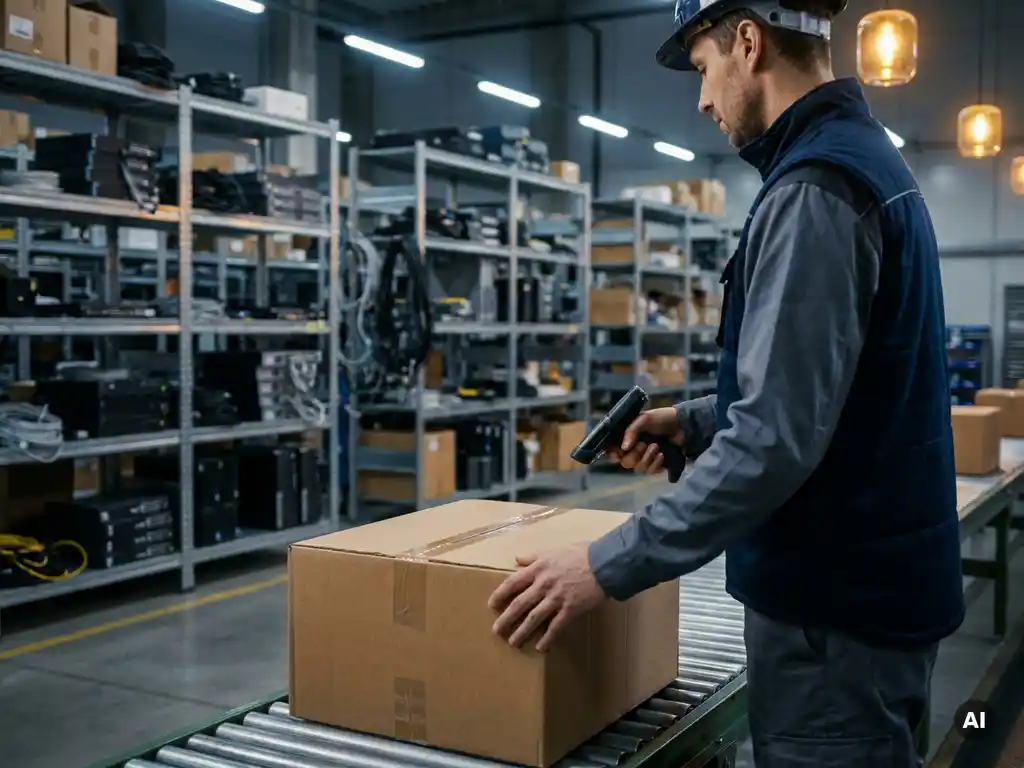
Outsourcing IT equipment fulfilment allows technology businesses to hand off warehousing, order processing, serialised inventory management, and distribution to a specialist logistics partner, freeing internal teams to focus on core operations. For companies handling routers, modems, networking hardware, or other technology products, the operational complexity involved makes specialist outsourcing particularly valuable. The questions below address the most common considerations when evaluating a fulfilment partner for IT equipment.
What types of IT equipment can be outsourced to a fulfilment partner?
A specialist fulfilment partner can manage a broad range of IT and technology hardware, including routers, modems, IP telephones, DECT systems, networking cables, fibre-optic products, servers, switches, and related accessories. Any product that requires careful handling, serialised tracking, or technical preparation before dispatch is well suited to outsourced IT equipment fulfilment.
Beyond standard networking and connectivity hardware, fulfilment partners experienced in technology logistics can also handle medical technology devices, set-top boxes, headsets, and professional audiovisual equipment. The common thread is that these products often require more than simple pick-and-pack operations. They may need individual serial number registration, specific packaging requirements, or pre-shipment configuration.
Telecom equipment fulfilment is a particularly common use case. Telecommunications operators and internet service providers regularly need to ship large volumes of customer premises equipment, such as modems and routers, to residential and business customers. Managing this at scale internally is resource-intensive, which is why outsourcing to a partner with serialised inventory management capabilities is a practical solution.
How does outsourcing IT fulfilment reduce operational costs?
Outsourcing IT fulfilment reduces operational costs by eliminating the need to maintain dedicated warehouse space, invest in warehouse management technology, and employ a permanent logistics team. Instead of carrying fixed overhead regardless of order volumes, businesses pay for the capacity and services they actually use, which can lower costs during quieter periods and scale efficiently during peaks.
The cost benefits extend beyond warehouse rent. A fulfilment partner consolidates inbound shipments, manages stock efficiently, and reduces fulfilment errors that lead to costly re-shipments or returns. Mistakes in IT equipment orders, such as sending the wrong device or an unconfigured unit, are expensive to correct and damage customer relationships. Specialist B2B fulfilment operations are structured to minimise these errors through systematic quality checks and product-level traceability.
There are also indirect savings. Businesses no longer need to invest in a warehouse management system, staff training, or the operational management required to run a fulfilment operation. These resources can be redirected toward product development, sales, or customer support. That said, the actual savings depend on the individual situation, including current operational scale, product complexity, and existing infrastructure.
What happens to IT equipment returns when fulfilment is outsourced?
When IT equipment fulfilment is outsourced, returns are typically managed by the same partner, creating a coordinated reverse logistics process. Returned devices are received, inspected, and assessed for condition. Depending on the outcome, equipment may be reintegrated into available inventory, sent for repair, refurbished for resale, or flagged for responsible disposal.
Effective reverse logistics for technology products goes beyond simply receiving items back into the warehouse. Each returned unit should be individually identified, tested where appropriate, and tracked throughout the returns process. Serial number tracking is especially important here, as it allows businesses to identify exactly which device has been returned, its history, and its current condition.
Not every returned product can be refurbished or resold. The outcome depends on the device’s condition, age, and whether repair is economically viable. A good fulfilment partner provides clear, real-time reporting on returned stock so that businesses can make informed decisions about inventory recovery and replacement purchasing.
How does a fulfilment partner handle device configuration and firmware?
A fulfilment partner with technical services capabilities can prepare devices before dispatch by installing configuration files, updating firmware, and performing functional diagnostics. This means equipment arrives at its destination ready for immediate deployment, without requiring additional setup by the end customer or field technician.
This is particularly relevant for telecom operators and internet service providers deploying customer premises equipment. A modem or router that ships pre-configured with the correct firmware and network settings reduces installation time and support calls significantly. The same principle applies to IP telephone systems, DECT handsets, and other connectivity devices that require provisioning before use.
These technical services are integrated directly into the logistics workflow, which avoids the need to ship devices to a separate facility for preparation. By combining warehousing, configuration, and outbound distribution in one location, businesses reduce handling steps, shorten lead times, and lower the risk of errors during device preparation.
When should a technology business switch to outsourced IT fulfilment?
A technology business should consider outsourcing IT fulfilment when internal logistics operations are consuming significant management time, when fulfilment errors are increasing, or when the business is scaling faster than its warehouse infrastructure can support. These are practical signals that the logistics function has become a constraint rather than a capability.
Other clear indicators include:
- Difficulty maintaining accurate, product-level inventory records across a growing SKU range
- Increasing volumes of returned equipment that are not being processed efficiently
- Devices being shipped without proper configuration, leading to installation failures or returns
- Reliance on multiple disconnected providers for warehousing, technical preparation, and distribution
- Limited visibility into where stock is located or how individual serialised items are moving through the supply chain
The right moment to switch is often before these problems become critical. Transitioning during a period of controlled growth, rather than under operational pressure, gives the business time to onboard a partner properly and integrate systems without disruption. For businesses evaluating value-added logistics, outsourcing also opens access to capabilities such as co-packing, labelling, and inventory optimisation that would be difficult to build internally.
How BNS Data Logistics supports IT equipment fulfilment
BNS Data Logistics provides specialist B2B fulfilment and technology logistics services for businesses managing IT hardware, telecom equipment, and electronic devices. With operations based in the Netherlands and a focus on serialised product handling, BNS supports technology companies across the full product lifecycle.
- Serialised inventory management: Each product is registered and tracked by serial number using the Cosmos warehouse management system, providing product-level traceability throughout storage and distribution.
- Device configuration and firmware updates: BNS prepares equipment according to customer specifications before dispatch, reducing installation time and support requirements at the point of delivery.
- Returns and reverse logistics: Returned equipment is received, inspected, and assessed for repair, refurbishment, or reintegration, with real-time reporting to support inventory decisions.
- Value-added logistics: Services including repackaging, labelling, co-packing, and stock counting are integrated into the fulfilment workflow to improve efficiency and product readiness.
- Scalable B2B order fulfilment: BNS handles both individual orders and bulk shipments, supporting businesses as they grow without requiring investment in additional warehouse infrastructure.
If your business is evaluating outsourced IT fulfilment or looking to improve how technology equipment is managed, stored, and distributed, contact BNS Data Logistics to discuss your specific requirements.
Gerelateerde artikelen
- How can internet service providers manage thousands of customer-owned devices?
- How do fulfilment providers track individual devices from warehouse to customer?
- How can serial number tracking improve the distribution of telecom equipment?
- How can technology companies improve the fulfilment of serialized products?
- What should internet service providers look for in a fulfilment partner?