
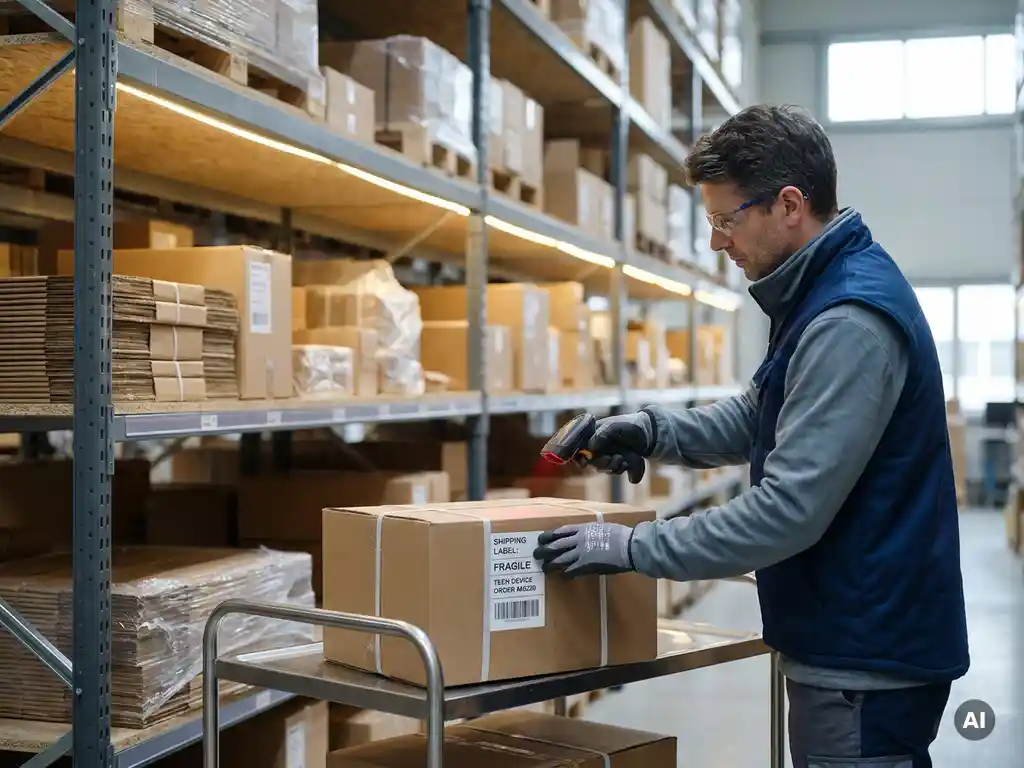
Fulfilment providers track individual devices from warehouse to customer using serialised inventory management, a method that assigns a unique identifier, typically a serial number or barcode, to each device at the point of receipt. Every subsequent movement, from storage location to outbound shipment, is recorded against that identifier in a warehouse management system. This gives both the provider and the client a complete, auditable trail for every individual unit.
For businesses handling IT hardware, routers, modems, or other technology products, this level of traceability is not a luxury: it is an operational necessity. The sections below unpack each stage of that tracking process and explain what to look for when evaluating a fulfilment partner’s capabilities.
What methods do fulfilment providers use to assign unique identities to devices?
Fulfilment providers assign unique identities to devices through serialised registration, which links each physical unit to a distinct identifier such as a manufacturer serial number, IMEI, MAC address, or a provider-assigned barcode or QR code. This registration typically happens during goods receipt, before the device enters active storage, ensuring every unit is individually identifiable from the moment it arrives.
In practice, the process works as follows. When an inbound shipment arrives, warehouse operatives scan or manually record each device’s existing serial number. If a product lacks a manufacturer identifier, or if the client requires an additional internal reference, the provider applies a barcode or QR code label during intake. That label becomes the device’s identity within the warehouse management system.
For technology products in particular, serialised registration serves purposes beyond simple tracking. A router or modem may need to be linked to a specific customer account, configuration profile, or firmware version. Recording the serial number at intake makes it possible to associate that device with downstream technical requirements before it ever leaves the warehouse. This is especially relevant for IT equipment fulfilment, where individual device identity directly affects deployment readiness.
Some providers also capture additional attributes during registration, such as product condition, packaging integrity, or batch reference, creating a richer record that supports quality control and downstream reporting.
How does a warehouse management system track a device’s location in real time?
A warehouse management system (WMS) tracks device location in real time by recording every movement event, from bin to shelf, shelf to pick station, pick station to dispatch, against the device’s unique identifier. Each scan updates the system’s location record instantly, so the current position of any individual unit is always known without a physical search.
Modern warehouse environments divide storage into named locations: aisles, bays, shelves, and bins. When a device is placed in a specific bin, the operative scans both the bin barcode and the device identifier. The WMS records the pairing. If the device is later moved, for a stock count, a quality check, or a replenishment task, the same scan-on-arrival, scan-on-departure logic updates the location record accordingly.
For businesses managing large volumes of technology hardware, this real-time visibility has practical consequences. It reduces the time spent locating specific units, prevents picking errors caused by mixed stock, and provides clients with accurate inventory positions at any given moment. A well-implemented WMS also generates alerts when stock falls below defined thresholds or when a device has remained in a location longer than expected, supporting proactive inventory management rather than reactive firefighting.
The quality of location tracking depends heavily on how consistently scanning discipline is maintained across all warehouse tasks. Providers with structured operational processes and regular stock audits tend to deliver more reliable location data than those relying on periodic manual counts.
What happens to device tracking data during picking, packing, and shipping?
During picking, packing, and shipping, device tracking data is updated at each stage to confirm that the correct unit has been selected, prepared, and dispatched. The serial number is scanned at pick, verified against the order at packing, and linked to the outbound shipment reference, creating a continuous, order-level record that connects a specific device to a specific customer delivery.
At the picking stage, the operative receives a task from the WMS specifying which device to retrieve and from which location. Scanning the device serial number confirms the correct unit has been picked and removes it from its storage location in the system. If the wrong device is scanned, for example, a unit with a different configuration or firmware version, the system flags the mismatch before the error progresses further.
During packing, the device is verified again against the order. This is the point at which additional items, accessories, documentation, or packaging inserts, are added, and the completed parcel is sealed and labelled. The WMS records the packed contents against the order reference, so there is a clear record of exactly what was included in each shipment.
At dispatch, the outbound shipment is linked to a carrier tracking number. This final scan connects the device’s serial number to the carrier’s tracking reference, giving both the provider and the client the ability to follow the parcel from warehouse exit to customer delivery. For telecom equipment fulfilment or B2B order fulfilment services involving high-value hardware, this end-to-end linkage is particularly important for resolving delivery disputes or confirming receipt.
How does serialised tracking support returns and reverse logistics?
Serialised tracking supports returns and reverse logistics by allowing a returned device to be immediately identified, matched to its original outbound record, and assessed against its known history. When a unit arrives back at the warehouse, scanning its serial number tells the system who it was shipped to, when, in what condition it left, and whether it has been returned before, enabling faster, more accurate triage decisions.
Without serialised tracking, returns processing often relies on visual inspection and manual documentation, which is slow and prone to error. With it, the process becomes structured. The returned device is scanned on arrival, its record is retrieved, and the operative can immediately see whether the unit requires inspection, repair, reconfiguration, or reintegration into available stock.
This matters particularly for businesses handling high volumes of returned technology products, routers, set-top boxes, medical devices, or IT hardware, where the condition and history of each unit determine its next step. A device that was dispatched in full working order and returned within days is a different case from one that has been in the field for two years. Serialised data makes that distinction visible and actionable.
Effective reverse logistics programmes also use serialised tracking to generate reporting on return rates, common fault patterns, and refurbishment outcomes. This operational data helps businesses identify product quality issues, improve packaging decisions, and reduce unnecessary replacement costs over time.
What should businesses look for in a fulfilment provider’s device tracking capabilities?
Businesses should look for a fulfilment provider that offers serial-number-level tracking across every stage of the fulfilment process, not just at inbound receipt or outbound dispatch. The key indicators are individual device registration at goods receipt, real-time location updates within the WMS, order-level serial number confirmation at packing, and the ability to retrieve a device’s full history during returns processing.
Beyond the basics, several additional capabilities signal a provider’s maturity in handling technology products:
- Integration with client systems: The provider should be able to share serialised inventory data with the client’s own ERP, ordering platform, or reporting tools, rather than keeping tracking data locked inside an internal system.
- Condition recording at intake: For businesses managing refurbishment or graded stock, the provider should capture product condition at receipt, not just the serial number.
- Support for technical preparation: If devices require configuration, firmware updates, or assembly before dispatch, the provider should link those technical steps to the device’s serial record. This is where technical services and serialised logistics genuinely complement each other.
- Returns traceability: The provider should be able to match any returned unit to its original outbound shipment and provide visibility into what happened to it after return.
- Scalable processes: Tracking discipline must hold as order volumes increase. Ask how the provider maintains scanning accuracy during peak periods and what audit processes are in place.
It is also worth asking about the provider’s value-added logistics services, capabilities such as labelling, repackaging, and co-packing, since these often intersect with device tracking during preparation for outbound shipment.
Ultimately, the right fulfilment partner for technology products is one that treats individual device identity as a core operational requirement, not an optional feature.
How BNS Data Logistics supports device tracking from warehouse to customer
BNS Data Logistics provides serialised inventory management and technology fulfilment services designed specifically for businesses handling IT hardware, telecom equipment, and other electronic devices. Using the proprietary Cosmos warehouse management and product information system, BNS maintains individual device traceability across every stage of the fulfilment process.
Here is how BNS supports businesses with the challenges covered in this article:
- Serial-number registration at goods receipt: Every device is individually registered on arrival, creating a traceable record from the moment it enters the warehouse.
- Real-time inventory location via Cosmos: Clients gain visibility into stock positions and individual device locations without relying on manual stock checks.
- Order-level serial confirmation at packing and dispatch: Each outbound shipment is verified against the correct device identifier before it leaves the warehouse, reducing fulfilment errors.
- Integrated technical preparation: Device configuration, firmware updates, and assembly are carried out within the same operational environment and linked to the device’s serial record, reducing handling steps and shortening lead times.
- Structured returns processing: Returned devices are matched to their outbound records, assessed for condition, and either reintegrated into stock or directed to repair and refurbishment workflows.
- Operational reporting: Cosmos provides data on inventory movements, return rates, and product history, supporting informed decision-making for clients managing complex hardware lifecycles.
If your business requires a fulfilment partner with proven serialised tracking capabilities for technology products, contact BNS Data Logistics to discuss your specific requirements.
Gerelateerde artikelen
- How can internet service providers manage thousands of customer-owned devices?
- How can serial number tracking improve the distribution of telecom equipment?
- What are the benefits of outsourcing IT equipment fulfilment?
- How can technology companies improve the fulfilment of serialized products?
- What should internet service providers look for in a fulfilment partner?