
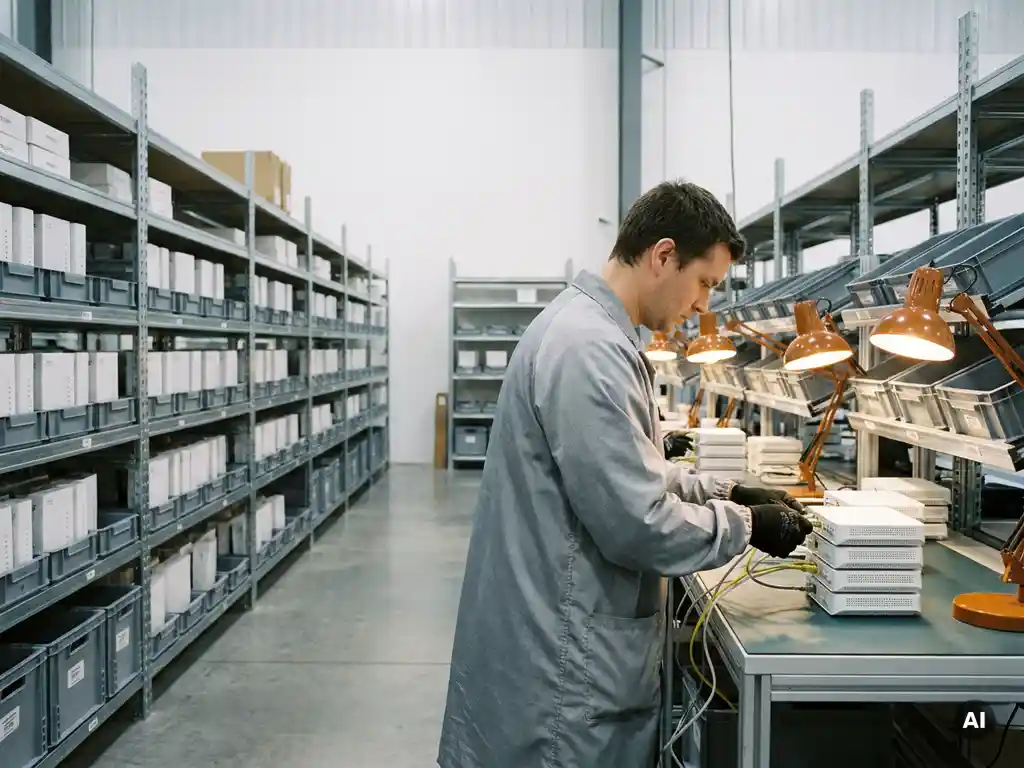
Internet service providers can manage thousands of customer-owned devices by combining serialised inventory management, structured logistics processes, and real-time tracking systems that follow each device from provisioning through to return. The scale involved (routers, modems, set-top boxes, and related customer premises equipment (CPE) distributed across tens or hundreds of thousands of subscribers) makes ad hoc approaches unsustainable. The sections below address the most common operational questions ISPs face when managing CPE at scale.
What makes managing customer-owned devices so complex for ISPs?
Managing customer premises equipment at scale is complex because ISPs must simultaneously track device identity, configuration state, location, and condition across a constantly changing subscriber base. Unlike standard warehouse stock, CPE devices are live assets that move between provisioning, active deployment, return, and reuse, often in high volumes and across multiple geographic regions.
Several factors compound this complexity. First, each device carries a unique identity: a serial number, MAC address, or IMEI that links it to a specific customer account, configuration profile, and service contract. Losing track of that identity at any point creates downstream problems: billing errors, misconfigured replacements, and gaps in warranty coverage.
Second, CPE devices are not static. A modem shipped to a new subscriber may be returned within weeks, assessed, reconfigured, and redeployed to another customer. This lifecycle requires a logistics operation that can handle inbound provisioning, outbound distribution, returns processing, and technical preparation as integrated steps rather than separate activities.
Third, ISPs typically operate with a mixed device estate: multiple hardware generations, different firmware versions, and varying configuration requirements depending on the service tier or region. Managing this variety without a structured system leads to mismatches, deployment delays, and increased support costs.
How do ISPs track thousands of devices across the customer base?
ISPs track devices at scale using serialised inventory management, which assigns a unique identifier to each unit and records its status, location, and history throughout its lifecycle. This approach, sometimes called serial number tracking, allows operations teams to know exactly where a device is, who it is assigned to, and what its current condition is at any point in time.
In practice, serialised tracking works by scanning each device at every significant handling point: goods receipt, technical preparation, outbound shipment, return receipt, and inspection. A warehouse management system (WMS) records each event against the device’s unique identifier, building a complete audit trail.
This level of traceability matters for several operational reasons:
- It enables accurate subscriber assignment, ensuring the correct device is linked to the correct customer account.
- It supports warranty and end-of-life decisions, since the full history of a device is available when assessing whether to repair, refurbish, or retire it.
- It reduces losses and shrinkage, because every unit is accounted for throughout the logistics chain.
- It simplifies compliance and reporting, particularly for ISPs operating under regulatory frameworks that require asset accountability.
Without serialised inventory management, ISPs often resort to batch-level tracking, which works reasonably well for new stock but breaks down quickly when managing returns, replacements, and refurbished units.
What happens to returned CPE devices after a customer cancels service?
When a customer cancels service and returns their CPE device, the equipment enters a reverse logistics process that determines its next use. The device is typically received, inspected, tested, and then classified, either for redeployment, repair, refurbishment, or responsible disposal, depending on its condition and age.
The returns process generally follows these steps:
- Receipt and registration: The returned device is scanned back into inventory using its serial number, closing the subscriber assignment and opening a new assessment record.
- Inspection and diagnostics: The unit is checked for physical damage and tested for functional integrity. Devices that pass inspection move towards reuse; those with faults are assessed for repair viability.
- Technical restoration: Where appropriate, devices are reset to factory settings, updated to current firmware, and reconfigured for redeployment. Cosmetic restoration may also be carried out if the device is intended for reuse.
- Classification and routing: Serviceable units are reintegrated into available stock. Devices beyond economic repair are directed towards responsible disposal or recycling.
Effective reverse logistics for CPE equipment can meaningfully reduce hardware procurement costs, since refurbished units returned to stock remove the need to purchase new replacements. The extent of these savings depends on return volumes, device condition, and the quality of the processing workflow.
How can ISPs ensure devices are correctly configured before shipping to customers?
ISPs can ensure correct device configuration by integrating technical preparation (including configuration-file installation and firmware updates) into the outbound logistics process before devices are shipped. This approach, often called pre-provisioning or staging, means devices arrive at the customer’s premises ready to activate rather than requiring a technician visit or remote configuration session.
Pre-shipment configuration typically involves loading the appropriate configuration profile onto the device, verifying firmware compatibility with the ISP’s network, applying any service-tier-specific settings, and confirming that the device identity is correctly registered in the subscriber management system.
Carrying out these steps within a logistics environment, rather than at the point of installation, reduces field errors, lowers the volume of support calls triggered by misconfigured equipment, and shortens the time between order and active service. It also allows ISPs to maintain tighter control over which firmware versions are in circulation, which is particularly relevant when managing large estates of older hardware.
Integrating device configuration services directly into the fulfilment workflow eliminates a separate handling step and reduces the risk of devices being shipped before preparation is complete.
When should an ISP outsource CPE logistics instead of managing it in-house?
An ISP should consider outsourcing CPE logistics when the operational complexity, volume, or technical requirements of managing customer premises equipment exceed what an internal team can handle efficiently and cost-effectively. This is typically the case when subscriber growth outpaces warehouse capacity, when returns volumes require dedicated processing resources, or when device configuration demands specialist technical capability.
Specific indicators that outsourcing deserves consideration include:
- Inventory inaccuracies that lead to fulfilment errors or stock discrepancies
- Limited visibility into device status across the subscriber base
- Growing returns backlogs that delay device reuse and increase replacement costs
- Inconsistent device configuration leading to avoidable support calls
- Difficulty scaling operations during subscriber growth or promotional periods
- High overhead costs associated with maintaining warehouse staff and infrastructure
Outsourcing to a specialist technology fulfilment partner allows ISPs to access structured logistics processes, serialised tracking systems, and technical services without building those capabilities internally. The decision ultimately depends on the ISP’s scale, growth trajectory, and the degree to which logistics is a core internal competency.
How BNS Data Logistics supports ISP device management
BNS Data Logistics provides end-to-end logistics and technical services for telecommunications operators and internet service providers managing large volumes of customer premises equipment. Our capabilities are specifically designed to address the operational challenges that arise when managing CPE at scale.
- Serialised inventory management: Every device is tracked by serial number throughout its lifecycle using our Cosmos warehouse management system, providing real-time visibility into stock location, status, and history.
- Device configuration and firmware preparation: Our technical team installs configuration files and applies firmware updates before outbound shipment, ensuring devices arrive ready for subscriber activation.
- Outbound fulfilment and distribution: We manage order processing, picking, packing, and shipping for both individual subscriber deliveries and bulk field deployments.
- Returns processing and reverse logistics: We receive, inspect, test, and classify returned CPE devices, routing serviceable units back into available inventory and managing unserviceable equipment responsibly.
- Refurbishment and technical restoration: Where devices meet the criteria for reuse, our specialists carry out repairs, cosmetic restoration, and reconfiguration to extend their operational life.
- Value-added logistics: We support labelling, repackaging, and other preparation activities that improve device readiness and reduce handling at the point of installation.
Whether you are looking to improve visibility across your device estate, reduce returns processing backlogs, or integrate technical preparation into your logistics workflow, BNS Data Logistics can help you design a process that fits your operational requirements. Contact us to discuss your CPE logistics challenges at bnsdl.com/contact.
Gerelateerde artikelen
- How do fulfilment providers track individual devices from warehouse to customer?
- How can serial number tracking improve the distribution of telecom equipment?
- What are the benefits of outsourcing IT equipment fulfilment?
- How can technology companies improve the fulfilment of serialized products?
- What should internet service providers look for in a fulfilment partner?