
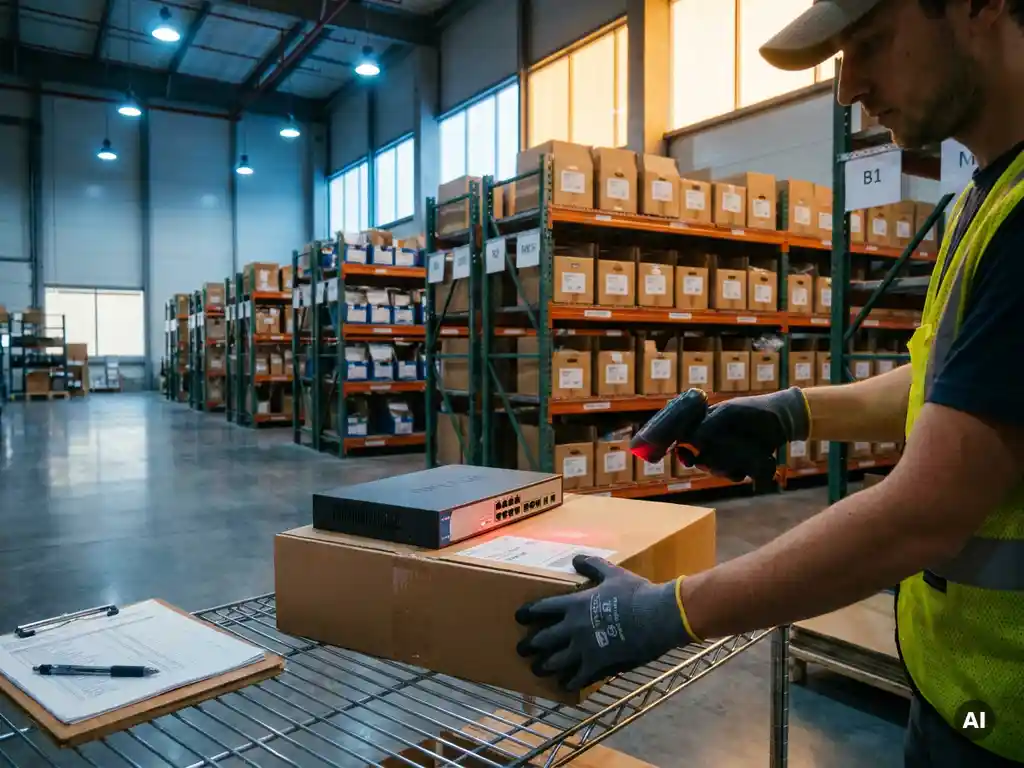
Serialised fulfilment supports product recalls and warranty management by linking every individual unit to a unique identifier (typically a serial number) that travels with the product throughout its entire logistics journey. This means that when a recall is issued or a warranty claim is raised, the relevant units can be identified, located, and acted upon precisely, rather than relying on batch estimates or manual records. The sections below explore the specific mechanisms that make this possible, from initial registration in the warehouse to returns processing and industry applications.
How does serial number tracking work in a fulfilment warehouse?
Serial number tracking in a fulfilment warehouse works by scanning and registering each product’s unique serial number at the point of receipt, then linking that identifier to every subsequent movement: storage location, order, shipment, and recipient. This creates a continuous, product-level audit trail within the warehouse management system, so the exact status and history of any individual unit can be retrieved at any time.
In practice, goods arrive at the warehouse and are scanned during inbound processing. Each serial number is recorded against a specific stock-keeping unit and assigned a storage location. When an order is picked, the system verifies that the correct serialised item is selected and logs the outbound shipment against the customer or destination. This prevents mix-ups, catches discrepancies early, and ensures that inventory records reflect actual physical stock rather than aggregated quantities.
The value of serialised inventory management becomes particularly clear with high-value or regulated products such as networking hardware, medical devices, or telecommunications equipment, where knowing precisely which unit went where is not just operationally useful but often a compliance requirement. Without serial number tracking, a warehouse can tell you how many units shipped; with it, it can tell you exactly which ones.
How does serialised fulfilment speed up a product recall?
Serialised fulfilment speeds up a product recall by enabling precise identification of affected units without having to quarantine entire batches or contact all customers indiscriminately. Because each unit’s serial number is recorded against its outbound shipment and recipient, the fulfilment operation can generate a targeted list of affected devices within minutes, rather than working backwards from broad production records.
Without serialised tracking, a recall typically involves identifying a production batch and then attempting to locate every unit within that batch, a process that is slow, imprecise, and often results in unnecessary disruption to customers who received unaffected units. With serial-level data, the scope of the recall is defined immediately: only the specific units that match the affected serial range need to be actioned.
This has practical consequences for both speed and cost. Outreach can be targeted to the right customers. Return logistics can be organised around confirmed unit counts. Replacement stock can be prepared in proportion to actual need. For IT equipment fulfilment and telecom equipment fulfilment operations handling large volumes of individually registered devices, this level of precision is a significant operational advantage when recalls occur.
What warranty data can be captured through serialised logistics?
Through serialised logistics, businesses can capture the shipment date, destination, product configuration, and full handling history of each individual unit, all of which are directly relevant to warranty management. This data allows warranty teams to verify whether a claim falls within the coverage period, confirm the original sale channel, and assess whether the product has been handled in a way consistent with its warranty terms.
In a serialised fulfilment environment, the warehouse management system logs when each unit was received, how it was processed, when it was shipped, and to whom. If the product also went through technical services, such as firmware installation or device configuration, those steps are recorded against the same serial number. This creates a complete product history that can be referenced when a warranty claim is submitted.
For B2B order fulfilment services handling products like routers, modems, IP telephones, or medical technology, this kind of granular data removes ambiguity from warranty decisions. Rather than relying on customer-provided purchase dates or incomplete documentation, the fulfilment partner can confirm the facts directly from its own records. This reduces disputes, shortens claim processing times, and supports more consistent warranty outcomes across large product volumes.
How does serialised tracking support reverse logistics and returns?
Serialised tracking supports reverse logistics by ensuring that every returned unit is matched to its original outbound record on arrival, giving the receiving team immediate context about the product’s age, configuration, and warranty status before inspection even begins. This makes returns processing faster, more accurate, and better connected to downstream decisions about repair, refurbishment, or disposal.
When a serialised product arrives at the returns facility, scanning the serial number retrieves its full history: when it shipped, what condition it was in, whether it has been through technical processing, and whether it falls within a warranty or recall programme. This context informs triage decisions. A unit returned within its warranty period can be fast-tracked for assessment. A unit outside warranty can be routed to a different workflow. Products flagged as part of a recall can be isolated immediately.
Serialised returns management also improves inventory reintegration. When a returned unit is inspected and found to be in working condition, the system can reinstate it as available stock under its original serial number, preserving its full history. This is particularly relevant for businesses operating circular product models, where refurbished units re-enter the supply chain and need accurate records to support resale or redeployment.
Which industries benefit most from serialised fulfilment?
The industries that benefit most from serialised fulfilment are those handling high-value, individually identifiable, or regulated products where traceability at unit level is operationally or legally significant. Telecommunications, IT hardware distribution, healthcare technology, and e-commerce businesses selling electronics are among the clearest examples, as each of these sectors regularly deals with recalls, warranty claims, device configuration requirements, or compliance obligations tied to individual product identities.
Telecommunications and internet service providers
Telecom operators and ISPs deploy large volumes of routers, modems, set-top boxes, and related devices to customers. Each device typically carries a unique identifier that links it to a specific subscriber. Serialised fulfilment allows these organisations to track which device was sent to which customer, manage firmware versions by unit, and handle returns or replacements with precision. This is essential for both operational efficiency and customer service quality.
IT hardware manufacturers and distributors
IT equipment fulfilment involves products where individual units may carry distinct configurations, firmware versions, or licence assignments. Serialised tracking ensures that the right product reaches the right destination and that any issues, whether a defect, a recall, or a configuration error, can be traced and resolved at unit level rather than across an entire product line.
Healthcare technology suppliers
Medical devices and healthcare equipment often carry regulatory requirements for individual unit traceability. Serialised logistics supports accurate delivery records, enables targeted recalls if a safety issue is identified, and provides the documentation needed to demonstrate compliance with product tracking requirements.
E-commerce businesses selling electronics
Online retailers handling networking products, consumer electronics, or technology accessories benefit from serialised inventory management because it reduces fulfilment errors, supports warranty verification, and makes returns processing more structured. As order volumes grow, the ability to track individual units becomes increasingly important for maintaining accuracy and managing product quality.
How BNS Data Logistics supports serialised fulfilment and product lifecycle management
BNS Data Logistics provides serialised fulfilment and product lifecycle services specifically designed for businesses managing IT hardware, telecommunications equipment, healthcare technology, and electronics. Our approach connects inbound logistics, warehousing, technical processing, and returns management through serial-number-level tracking within our proprietary Cosmos warehouse management system.
- Serialised inventory registration: Every unit is scanned and registered on arrival, with its serial number linked to storage location, order history, and outbound shipment records, giving you precise visibility at product level.
- Recall and warranty support: Cosmos records enable rapid identification of affected units in the event of a recall, and provide the shipment and handling data needed to process warranty claims accurately.
- Technical services integration: Device configuration, firmware updates, and diagnostics are logged against individual serial numbers, so the full preparation history of each unit is available throughout its lifecycle. Learn more about our technical services.
- Structured returns processing: Returned units are matched to their original records on arrival, enabling informed triage decisions and, where appropriate, refurbishment and reintegration into available stock.
- Scalable B2B fulfilment: Our fulfilment services are designed for technology businesses handling variable order volumes, with serialised tracking maintained consistently regardless of scale.
If your business manages products where individual unit traceability matters, whether for recalls, warranty management, compliance, or returns, contact BNS Data Logistics to discuss how our serialised logistics capabilities can support your operations. Reach our team directly via the BNS contact page.
Gerelateerde artikelen
- How can value-added logistics services simplify technology product distribution?
- How can international companies distribute IT equipment across Europe without their own warehouse?
- How can technology companies maintain real-time visibility of outsourced inventory?
- What are the advantages of combining IT fulfilment and reverse logistics?
- How can serial number tracking improve the distribution of telecom equipment?