
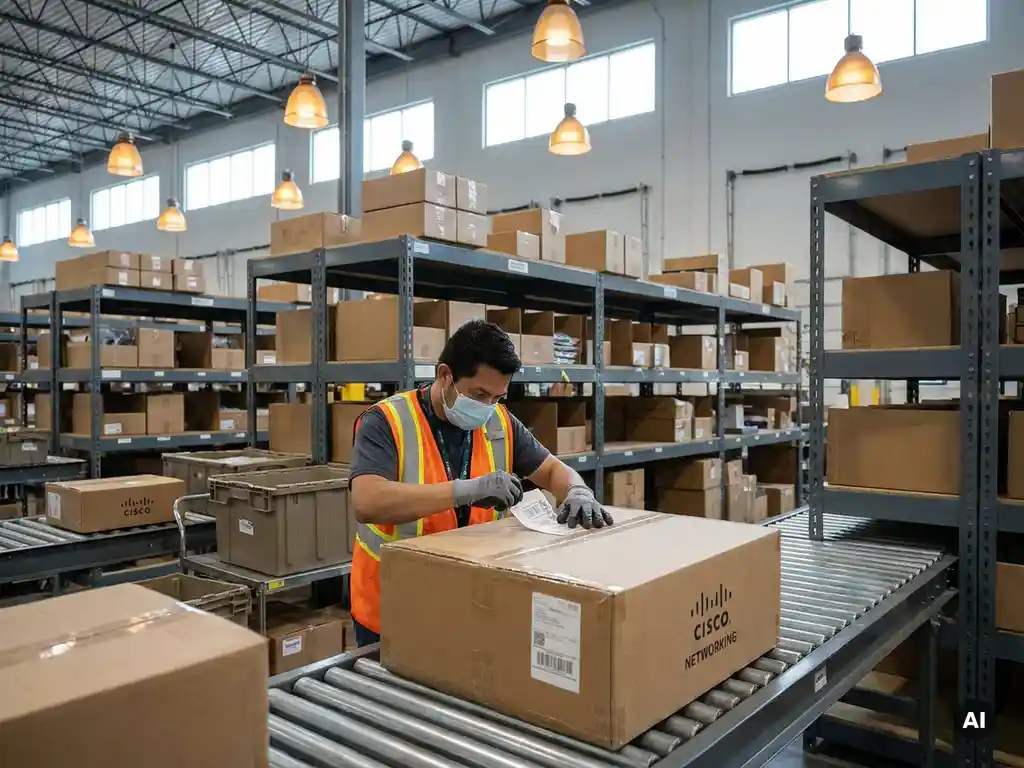
Value-added logistics services simplify technology product distribution by integrating specialist handling, labelling, configuration, and inventory management directly into the logistics workflow, reducing the number of separate steps, handoffs, and providers a business needs to coordinate. For technology distributors managing complex hardware, this means fewer delays, fewer errors, and greater control over product readiness before goods reach the customer. The questions below unpack exactly how this works in practice.
What types of value-added services are used in technology logistics?
In technology logistics, value-added services are specialist activities performed on products during storage or transit that go beyond basic pick-and-pack fulfilment. Common examples include serialised inventory registration, barcode and QR-code labelling, repackaging, co-packing, palletisation, physical stock counting, device configuration, firmware updates, and cosmetic restoration of returned equipment.
For IT hardware and telecom equipment specifically, these services often address a critical gap: products arrive at a warehouse in a state that is not yet ready for deployment or resale. A batch of routers, for instance, may need individual serial number registration, configuration-file installation, and repackaging before they can be shipped to end customers or field engineers. Performing these tasks within the same logistics environment eliminates the need for additional handling at a separate facility.
Other commonly used value-added logistics services in this sector include:
- Serialised processing and serial number tracking for individual device identification
- Custom labelling and packaging to meet customer or retailer requirements
- Kitting and co-packing of hardware bundles or accessory sets
- Quality and quantity checks on inbound shipments
- Refurbishment and cosmetic restoration of returned or end-of-life equipment
The specific mix of services depends on the product type, the customer’s supply chain structure, and the point in the product lifecycle at which goods are being handled.
How do value-added logistics services reduce distribution complexity?
Value-added logistics services reduce distribution complexity by consolidating multiple preparation and handling tasks into a single operational environment, removing the need to move products between different providers before they are ready to ship. Instead of coordinating a warehouse, a configuration specialist, and a repackaging facility separately, a technology distributor can manage all of these activities through one partner.
For businesses distributing IT equipment or telecom hardware at scale, this consolidation has a direct impact on lead times and error rates. Each additional handoff in a supply chain introduces the risk of miscommunication, lost serialisation data, incorrect configurations, or damaged packaging. Integrating value-added services into the warehouse operation reduces these touchpoints significantly.
There are several specific ways this simplification plays out in practice:
- Inventory visibility: When serialised processing and stock management happen in the same system, product-level traceability is maintained throughout: no data gaps between configuration and despatch.
- Faster order readiness: Products can be prepared, labelled, and configured ahead of demand peaks, reducing the time between order receipt and shipment.
- Fewer logistics providers: Consolidating services under one partner simplifies procurement, invoicing, and accountability.
- Reduced transport cycles: Products that would otherwise travel between a warehouse and a separate technical facility can be processed in one location, cutting unnecessary movement.
For B2B fulfilment in particular, where orders often involve specific configurations or compliance requirements, this level of integration makes a measurable difference to operational reliability.
What is the difference between standard fulfilment and value-added logistics?
Standard fulfilment covers the core logistics activities of receiving goods, storing them, picking and packing orders, and arranging outbound delivery. Value-added logistics extends this by incorporating additional preparation, processing, or technical tasks that adapt the product to specific requirements before it reaches the customer. The key distinction is product transformation: standard fulfilment moves products as they are; value-added logistics changes their state, configuration, or presentation.
In practice, a standard fulfilment operation handles a modem by receiving it, assigning it a storage location, picking it when an order arrives, and packing it for despatch. A value-added fulfilment operation might also register the device’s serial number, install a configuration file, apply a customer-specific label, and bundle it with relevant accessories, all before the item leaves the warehouse.
For technology product distribution, this difference is significant. Many IT hardware and telecom products cannot simply be picked and packed without preparation. They require device-level identification, technical readiness checks, or specific packaging that reflects the end customer’s requirements. Standard fulfilment alone does not accommodate these needs, which is why technology distributors and telecom operators increasingly rely on value-added logistics services as a core part of their supply chain.
When should a technology distributor outsource value-added logistics?
A technology distributor should consider outsourcing value-added logistics when in-house preparation activities are creating bottlenecks, absorbing significant staff time, or introducing errors that affect product quality or delivery reliability. If your team is spending operational hours on labelling, repackaging, serial number registration, or device configuration (tasks that fall outside your core business), outsourcing these to a specialist logistics partner is worth evaluating seriously.
Several specific situations signal that outsourcing makes operational sense:
- Scaling volumes: When order volumes increase and internal capacity cannot keep pace without additional investment in space, equipment, or headcount.
- Product complexity: When products require serialised inventory management, firmware updates, or configuration-file installation that demand specialist processes and systems.
- Multiple providers: When you are currently coordinating warehousing, technical preparation, and packaging across separate suppliers, creating fragmented reporting and accountability gaps.
- Returns pressure: When returned equipment requires inspection, testing, or refurbishment before it can re-enter available stock, and your internal operation lacks the capacity or expertise to handle this efficiently.
- Geographic reach: When you need a fulfilment partner in Europe with the infrastructure to support distribution across multiple markets from a single location.
Outsourcing value-added logistics does not suit every situation. For businesses with highly standardised products, low complexity, and stable volumes, the case is less compelling. But for technology distributors managing diverse hardware portfolios, varying customer requirements, and lifecycle considerations, a specialist partner often delivers both operational and commercial advantages.
How do value-added logistics services support circular economy goals?
Value-added logistics services support circular economy goals by enabling the inspection, restoration, and reintegration of returned or end-of-life technology products rather than defaulting to disposal or replacement. Activities such as diagnostics, cosmetic restoration, refurbishment, and firmware updates can extend a product’s usable life through multiple cycles, reducing electronic waste and the demand for new hardware.
In a linear supply chain, a returned modem or defective router is often written off and replaced. In a circular model, that same device can be assessed, repaired if needed, reconfigured, repackaged, and returned to available inventory, provided its condition supports it. Value-added logistics services make this process operationally viable by integrating technical restoration into the returns and warehousing workflow.
For sustainability managers and operations teams working toward circular economy targets, this integration matters for several reasons. It reduces the volume of equipment sent for recycling or disposal. It recovers residual value from returned stock. And it provides the product-level data (through serialised tracking and condition assessment) needed to make informed decisions about repair, reuse, or responsible end-of-life handling.
It is worth noting that not every returned product can be refurbished or resold. The outcome depends on the product type, its condition on return, and the technical and commercial viability of restoration. However, structured reverse logistics combined with value-added processing gives businesses the operational framework to recover value where it genuinely exists, rather than losing it by default.
How BNS Data Logistics supports value-added technology distribution
BNS Data Logistics provides integrated value-added logistics services designed specifically for businesses managing IT hardware, telecom equipment, and other technology products. Rather than treating logistics and product preparation as separate workflows, BNS combines these into a coordinated operation from a single facility in the Netherlands.
For technology distributors and B2B fulfilment operations, BNS offers practical support across the following areas:
- Serialised inventory management: Individual device registration and serial number tracking through the Cosmos warehouse management system, maintaining product-level traceability throughout storage and distribution.
- Value-added processing: Barcode and QR-code labelling, repackaging, co-packing, palletisation, and physical stock counting integrated directly into the warehousing operation.
- Technical preparation: Device configuration and firmware updates performed within the logistics workflow, so products arrive ready for deployment or installation.
- Returns and refurbishment: Structured inspection, diagnostics, cosmetic restoration, and reintegration of returned equipment where the product’s condition supports it, supporting both operational efficiency and circular economy objectives.
- Consolidated operations: A single partner managing inbound logistics, warehousing, value-added services, and outbound distribution, reducing the number of providers, handoffs, and reporting gaps in your supply chain.
Whether you are a telecom operator managing large volumes of customer equipment, an IT hardware distributor handling diverse product configurations, or an e-commerce business seeking a reliable fulfilment partner in Europe, BNS Data Logistics can help you simplify your distribution operation. Contact BNS Data Logistics to discuss your specific logistics requirements.
Gerelateerde artikelen
- What are the main challenges of warehousing electronic devices?
- How does IT equipment fulfilment differ from standard B2B fulfilment?
- How can technology manufacturers outsource warehousing and order fulfilment in Europe?
- How can serial number tracking improve the distribution of telecom equipment?
- What should internet service providers look for in a fulfilment partner?