
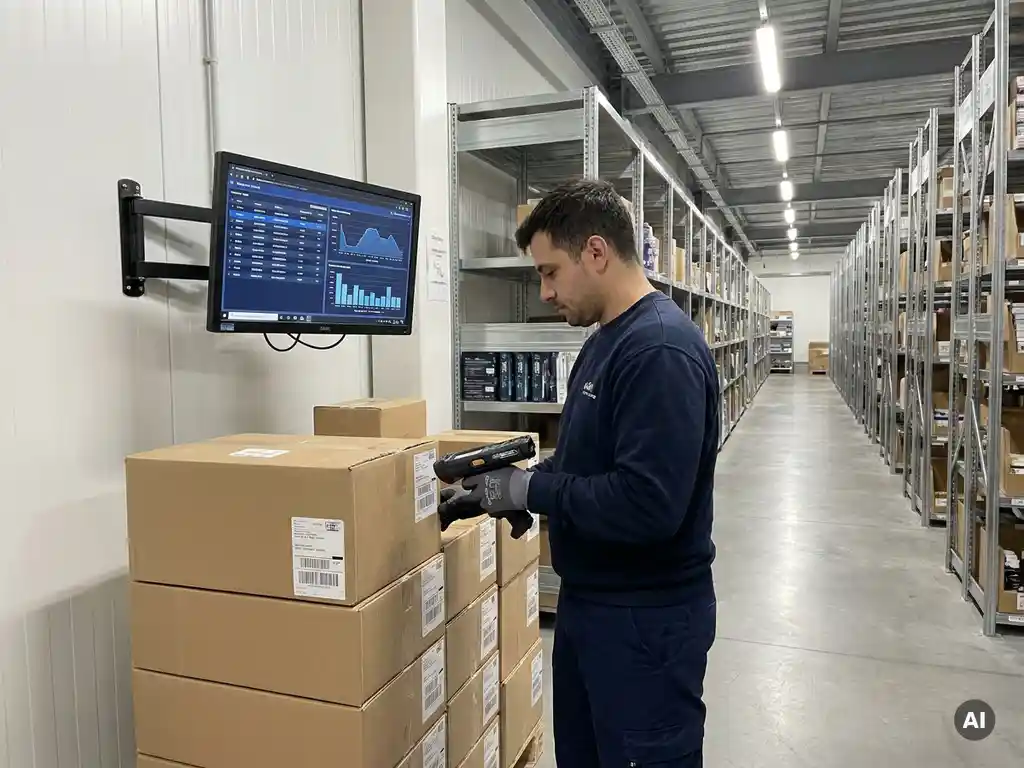
Technology companies can maintain real-time visibility of outsourced inventory by working with a fulfilment partner that provides a warehouse management system (WMS) with live data access, serialized product tracking, and structured reporting. The key is selecting a 3PL that treats inventory data as a shared operational resource rather than an internal record kept out of sight. The sections below address the most common questions around achieving and sustaining that visibility.
What tools give technology companies live inventory data from 3PL partners?
The primary tool is a warehouse management system that offers client-facing access to live stock data. A well-configured WMS allows technology companies to view current stock levels, inbound receipts, outbound shipments, and product locations in real time, without waiting for scheduled reports or manual updates from the 3PL. Integration capabilities matter equally: the WMS should connect with your ERP, e-commerce platform, or order management system via API or EDI to keep data consistent across systems.
Beyond the WMS itself, dashboards and business intelligence portals are increasingly common. These consolidate inventory data into visual summaries, making it easier for supply chain managers to spot discrepancies, monitor stock movements, and flag potential shortfalls before they affect operations. For companies managing IT hardware, routers, modems, or other serialized equipment, the ability to track individual units by serial number within the same platform is essential rather than optional.
A practical checklist of tools to look for includes:
- A client-accessible WMS with real-time stock and location data
- API or EDI integration with your existing business systems
- Serialized inventory tracking at the individual unit level
- Automated alerts for low stock, failed receipts, or shipment exceptions
- Exportable reporting for auditing and reconciliation purposes
How does serialized tracking improve visibility over outsourced hardware?
Serialized tracking assigns a unique identifier, typically a serial number, to each individual unit of hardware. This means every device, whether a router, modem, IP telephone, or medical device, can be traced through every stage of the logistics process: receipt, storage, order fulfilment, shipping, and return. For technology companies, this level of granularity is the difference between knowing you have 500 units in stock and knowing exactly which 500 units they are and where each one is located.
When inventory is outsourced without serialized tracking, stock counts become aggregate figures that cannot account for individual device histories, firmware states, or condition records. This creates problems in several practical scenarios: a telecom operator cannot confirm which specific modems have been configured and which have not; an IT distributor cannot verify whether a returned unit is the same one that was originally shipped; a healthcare technology supplier cannot demonstrate device-level traceability for compliance purposes.
Serialized inventory management also simplifies returns processing. When a specific unit comes back, its history is immediately accessible, enabling faster condition assessment and more accurate decisions about whether the device can be reintegrated into stock, repaired, or retired. This connects directly to reverse logistics efficiency, where traceability at the unit level reduces manual investigation and processing time.
What data should a 3PL provide in real-time inventory reports?
A 3PL providing genuine real-time inventory visibility should deliver reports that cover current stock levels by SKU and location, inbound receipts with confirmation of quantities and condition checks, outbound fulfilment activity including pick, pack, and despatch records, and the status of any returned or pending items. For technology products, serial number data should be included at each of these stages rather than tracked separately.
Beyond transactional data, useful real-time reporting includes:
- Stock ageing data: identifying units that have been in storage for extended periods, which matters for firmware relevance and product lifecycle decisions
- Location mapping: showing exactly where within the warehouse specific products or batches are stored
- Exception reporting: flagging discrepancies between expected and received quantities, damaged goods on arrival, or failed quality checks
- Returns status: tracking returned units through inspection and condition grading in real time
- Order fulfilment metrics: accuracy rates, processing times, and any outstanding orders
The format matters too. Data should be accessible on demand rather than delivered only at fixed intervals. Scheduled weekly reports are useful for planning, but they are not a substitute for live access when an operational decision needs to be made quickly.
Why do technology companies lose inventory visibility when outsourcing logistics?
Technology companies typically lose inventory visibility when outsourcing because the 3PL treats stock data as an internal operational record rather than a shared resource. The warehouse management system is configured for the 3PL’s own processes, and the client receives only periodic summaries, often in spreadsheet format, rather than live access to the underlying data. This creates an information gap that grows wider as order volumes increase.
Several structural factors contribute to this problem. First, many general-purpose 3PLs are not equipped to handle serialized inventory, so technology products are processed as bulk stock without unit-level tracking. Second, integration between the 3PL’s WMS and the client’s ERP or order management system is often absent or poorly maintained, forcing manual reconciliation. Third, returns and inbound receipts may be processed in batches rather than in real time, meaning the client’s inventory view is always slightly behind actual warehouse activity.
There is also a contractual dimension. Visibility capabilities are sometimes not specified in service agreements, so clients discover limitations only after outsourcing has begun. By that point, switching providers or renegotiating data access carries significant operational disruption. This is why evaluating visibility capabilities before committing to a 3PL partnership is a critical step rather than a secondary consideration.
How should technology companies evaluate a 3PL’s visibility capabilities before outsourcing?
Technology companies should evaluate a 3PL’s visibility capabilities by requesting a demonstration of the warehouse management system before signing any agreement. A credible 3PL will be able to show, in a live environment, how client inventory data is displayed, what level of detail is available, how frequently it updates, and how it can be accessed or integrated with external systems. A provider that cannot demonstrate this clearly is unlikely to deliver it in practice.
Beyond the system demonstration, the evaluation should address the following questions directly:
- Does the WMS support serialized inventory management? If the 3PL cannot track individual units by serial number, it is not suited to IT hardware, telecom equipment, or medical devices.
- What integration options exist? Ask specifically about API connectivity, EDI support, and which platforms the 3PL has already connected to successfully.
- How are inbound receipts and returns processed? Real-time updates at goods-in and returns stages are as important as outbound tracking.
- What reporting is included as standard, and what requires additional configuration? Understand the baseline before negotiating extras.
- Who owns the data? Confirm in writing that inventory data belongs to your company and can be exported in full at any time.
References from existing clients in comparable industries, particularly other technology or telecom businesses, can also provide useful evidence of how the 3PL performs in practice. A provider experienced in value-added logistics for technology products will understand the specific data requirements that come with serialized hardware, configuration tracking, and equipment lifecycle management.
How BNS Data Logistics supports real-time inventory visibility for technology companies
BNS Data Logistics provides IT equipment fulfilment and B2B order fulfilment services built around Cosmos, its proprietary warehouse management system. Cosmos gives clients direct access to live inventory data, including serialized inventory management at the individual unit level, making it suited to technology companies managing routers, modems, networking hardware, healthcare devices, and other serialized equipment.
For technology companies evaluating a fulfilment partner in Europe, BNS offers the following capabilities directly relevant to inventory visibility:
- Real-time stock access via Cosmos: clients can view current inventory levels, product locations, and movement history without relying on scheduled reports
- Serial number tracking: every unit is registered and traceable from inbound receipt through fulfilment and into any returns process
- Inbound and returns processing with condition recording: goods are registered on arrival and returned items are assessed and updated in the system promptly
- Value-added logistics services: including barcode and QR-code labelling, repackaging, and stock counting, all recorded within the same inventory system
- Reverse logistics integration: returned hardware is tracked through inspection and, where appropriate, reintegrated into available stock with full traceability
If your business is managing outsourced inventory for technology products and needs clearer, more reliable visibility into stock movements and individual device histories, contact BNS Data Logistics to discuss how our services can support your operations. Visit bnsdl.com/contact to get in touch.
Gerelateerde artikelen
- What are the advantages of real-time inventory reporting for telecom operators?
- How does IT equipment fulfilment differ from standard B2B fulfilment?
- What are the advantages of combining IT fulfilment and reverse logistics?
- Why is specialized fulfilment important for high-value electronic equipment?
- What should internet service providers look for in a fulfilment partner?