
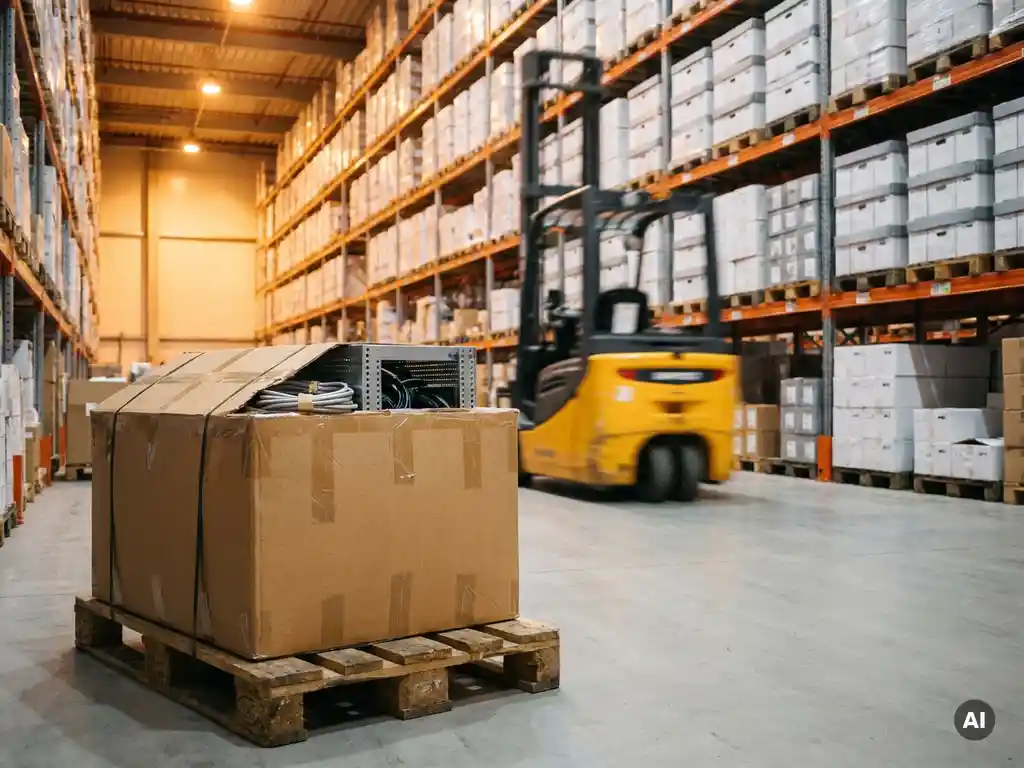
International companies can distribute IT equipment across Europe without their own warehouse by partnering with a third-party logistics provider (3PL) that operates European fulfilment infrastructure. This approach gives businesses access to professional warehousing, inventory management, and distribution capabilities without the capital investment and operational complexity of running their own facility. The sections below address the most common questions around cross-border IT equipment distribution in Europe.
What logistics options exist for distributing IT equipment across Europe?
International companies distributing IT equipment across Europe have several logistics options available, ranging from establishing their own regional warehouse to partnering with a 3PL provider or using a fulfilment network. For most technology businesses without an existing European footprint, outsourcing to a specialist fulfilment partner in a central European location offers the most practical and scalable starting point.
The main options worth considering include:
- Own warehouse: Setting up and operating a dedicated European facility. This offers maximum control but requires significant upfront investment in property, staffing, systems, and compliance.
- 3PL fulfilment partner: Outsourcing warehousing and distribution to a specialist logistics provider. The 3PL stores inventory, processes orders, and handles outbound shipping on behalf of the client.
- Fulfilment network or marketplace logistics: Using platform-based fulfilment services tied to specific sales channels. These are often limited in flexibility and may not support B2B order structures or serialised inventory requirements.
- Drop-shipping from manufacturer: Having products shipped directly from the manufacturer to the end customer. This eliminates storage costs but reduces control over delivery times, packaging, and product preparation.
For B2B technology companies managing hardware such as networking equipment, routers, or telecom devices, a dedicated 3PL with experience in IT equipment fulfilment is typically the most effective option. These providers can handle the technical requirements of the product category, including serial number tracking, device configuration, and structured returns handling, which general logistics providers often cannot support at the same level.
What are the biggest challenges of cross-border IT equipment distribution in Europe?
The biggest challenges of cross-border IT equipment distribution in Europe include regulatory complexity, serialised inventory management, customs and VAT compliance, and maintaining consistent delivery standards across multiple countries. These challenges are compounded when products require technical preparation before deployment or when returns need to be processed and reintegrated into stock.
Regulatory and compliance complexity
Europe is not a single logistics market. While EU member states share many trade rules, VAT registration requirements, product compliance obligations, and import procedures still vary between countries. Companies shipping from outside the EU need to account for customs clearance, import duties, and local documentation requirements. Even intra-EU distribution involves navigating different carrier networks, address standards, and delivery expectations.
Product-level traceability and serialised inventory
IT hardware, telecom equipment, and networking devices are typically high-value, serialised products. Each unit has a unique serial number that must be tracked throughout the supply chain, from goods receipt through storage, order fulfilment, and eventual return. Managing this level of traceability requires a warehouse management system capable of registering and querying individual serial numbers, not just SKU-level stock counts. Without this capability, inventory discrepancies and fulfilment errors become difficult to investigate or prevent.
Technical preparation and device readiness
Many technology products cannot simply be picked, packed, and shipped. Routers, modems, IP phones, and similar devices often require configuration-file installation, firmware updates, or functional testing before they reach the end customer or field technician. Coordinating this technical preparation within a logistics workflow adds complexity that standard fulfilment providers are not always equipped to handle.
How does a 3PL partner manage IT equipment fulfilment on behalf of an international company?
A 3PL partner manages IT equipment fulfilment by taking responsibility for the entire physical logistics process: receiving inbound shipments, registering products into a warehouse management system, storing inventory, processing orders, picking and packing individual units, coordinating outbound shipping, and handling returns. The international company retains commercial control while the 3PL handles day-to-day operational execution.
In practice, the process typically works as follows. When stock arrives at the 3PL’s facility, the goods are checked for quantity and condition, and individual items are registered against their serial numbers in the warehouse management system. This creates a product-level inventory record that remains traceable throughout the product’s time in the warehouse.
When an order is placed, the 3PL’s system identifies the correct unit, picks it from storage, applies any required packaging or labelling, and coordinates dispatch through the appropriate carrier for the destination country. For technology products that require preparation before shipping, such as pre-configured networking hardware, the 3PL can integrate technical services into the fulfilment workflow, reducing the need to move products between separate facilities.
Throughout this process, the client company receives visibility into stock levels, order status, and product movements through the 3PL’s reporting tools. This operational transparency is particularly important for companies managing inventory across borders without direct access to the warehouse floor.
What should international companies look for in a European IT logistics partner?
International companies selecting a European IT logistics partner should prioritise experience with technology products, serialised inventory management capability, the ability to handle technical preparation within the logistics workflow, and transparent reporting. A partner that meets these criteria reduces the risk of fulfilment errors, improves delivery reliability, and supports more complex operational requirements as the business grows.
Key criteria to evaluate include:
- Product category experience: The partner should have demonstrable experience handling IT hardware, telecom equipment, or electronics, not just general consumer goods. Technology products have specific handling, storage, and traceability requirements.
- Serial number tracking: The warehouse management system must support serial-number-based inventory registration and order fulfilment. This is essential for high-value B2B products and for managing returns accurately.
- Technical capabilities: If products require configuration, firmware updates, assembly, or testing before shipment, the partner should be able to perform these tasks on-site rather than requiring a separate service provider.
- Value-added logistics services: Capabilities such as repackaging, custom labelling, co-packing, and palletisation are often needed for B2B order fulfilment and should be available as part of the service offering.
- Reverse logistics support: Returns are an unavoidable part of technology distribution. A partner with structured reverse logistics processes, including inspection, condition assessment, and inventory reintegration, reduces the cost and complexity of managing returned equipment.
- Geographic location: A centrally located European warehouse, such as one in the Netherlands or Belgium, typically offers efficient access to major European markets and well-developed carrier networks.
- Quality and security certifications: ISO 9001 for quality management and ISO 27001 for information security are relevant certifications for companies handling sensitive or high-value technology products.
How does outsourced European distribution support circular economy and sustainability goals?
Outsourced European distribution supports circular economy and sustainability goals by enabling structured returns processing, product refurbishment, and inventory reintegration within a single operational framework. Rather than disposing of returned or end-of-life equipment, a logistics partner with technical capabilities can assess, repair, and restore products for reuse, reducing electronic waste and recovering residual product value.
For technology companies under pressure to reduce their environmental footprint, this operational approach offers a practical route to circular product management. When returns are handled by a partner with both logistics and technical expertise, each returned unit can be inspected, diagnosed, and directed toward the most appropriate outcome, whether that is restocking, refurbishment, component recovery, or responsible disposal.
The value-added logistics capabilities of a specialist 3PL also reduce unnecessary product movement. When configuration, testing, and preparation happen in the same facility as warehousing and fulfilment, products travel fewer times between locations, which lowers transport-related emissions and shortens operational timelines.
It is worth noting that not every returned product can be refurbished or resold. The feasibility depends on the product type, its condition on return, and the technical effort required to restore it. A transparent logistics partner will provide condition assessments and clear reporting so that companies can make informed decisions about each product rather than assuming a fixed recovery rate.
How BNS Data Logistics supports European IT equipment distribution
BNS Data Logistics provides specialist B2B fulfilment and product lifecycle services for technology companies distributing IT equipment, telecom hardware, and networking products across Europe. Operating from its facility in Vianen, the Netherlands, BNS offers international companies a practical alternative to establishing their own European warehouse.
Specifically, BNS supports cross-border IT equipment distribution in the following ways:
- Serialised inventory management: Products are registered and tracked at the individual serial number level using the Cosmos warehouse management system, providing full product-level traceability from goods receipt through to delivery.
- B2B order fulfilment: BNS handles inbound logistics, secure storage, order picking, packaging, and outbound distribution for both individual and bulk technology product orders.
- Technical services on-site: Device configuration, firmware updates, functional testing, and cosmetic restoration are performed within the same operational facility, reducing the need for additional handling or external service providers.
- Reverse logistics and returns management: Returned equipment is inspected, assessed, and directed toward repair, refurbishment, or responsible disposal, supporting both operational efficiency and sustainability objectives.
- Value-added logistics: Repackaging, labelling, palletisation, and co-packing services are available to support complex B2B order requirements.
- Reporting and visibility: Clients receive operational insight into inventory movements, order status, and returned product conditions through BNS’s Cosmos platform.
If your company is looking to establish or improve its European distribution capability for IT or telecom equipment without the overhead of running your own warehouse, contact BNS Data Logistics to discuss your requirements.
Gerelateerde artikelen
- How can outsourced inventory management reduce operational costs for technology companies?
- How do you choose a fulfilment provider for serialized electronic devices?
- How can technology manufacturers outsource warehousing and order fulfilment in Europe?
- How do fulfilment providers track individual devices from warehouse to customer?
- What are the benefits of outsourcing IT equipment fulfilment?