
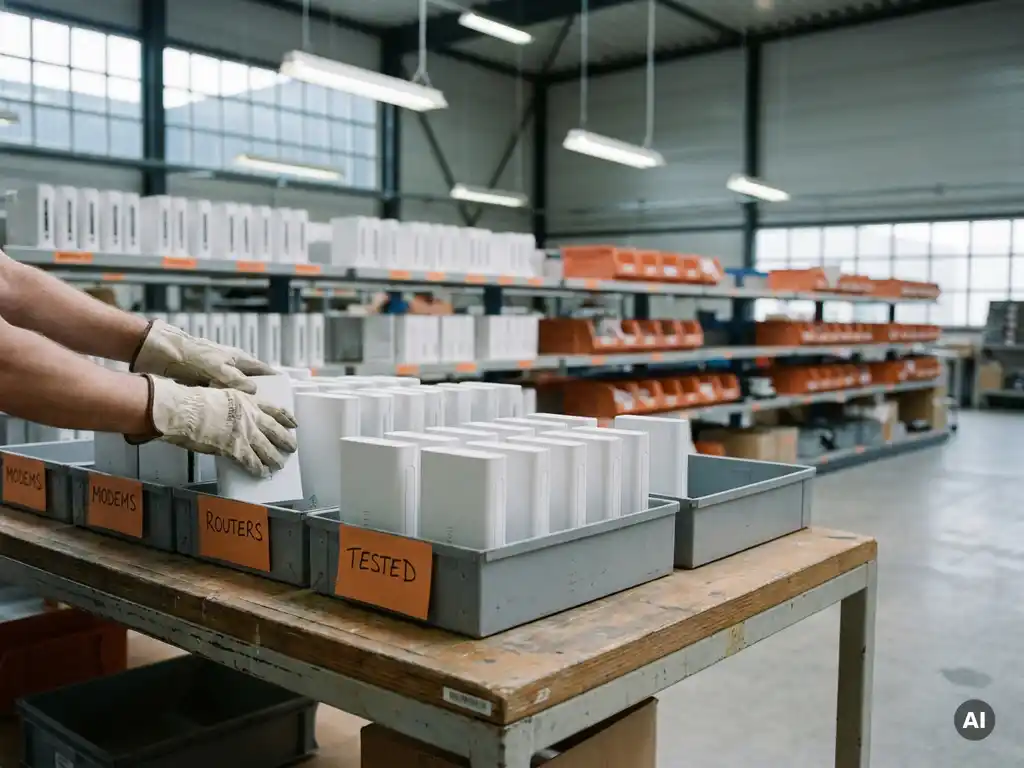
Telecom operators can reduce errors in modem and router distribution by implementing serialised inventory management, integrating firmware and configuration checks into the logistics workflow, and applying structured returns processing before equipment re-enters stock. These measures address the three most common failure points: incorrect device assignment, misconfigured hardware, and contaminated inventory from unprocessed returns.
For operators managing thousands of customer premises equipment (CPE) units across residential and business subscriber bases, even small error rates translate into significant operational costs, repeat dispatch visits, and customer dissatisfaction. The sections below examine each failure point and the logistics processes that prevent them.
What causes distribution errors in modem and router fulfilment?
Distribution errors in modem and router fulfilment most commonly stem from inadequate product-level tracking, poor inbound quality control, and manual processes that introduce human error at picking and packing stages. When equipment is stored and managed by product type rather than by individual serial number, it becomes difficult to verify that the correct device reaches the correct subscriber.
Several factors compound the problem in telecom equipment fulfilment:
- Bulk storage without serialised registration: If modems and routers are received and stored as generic units rather than individually registered items, there is no mechanism to prevent the wrong model or firmware version from being picked.
- Inadequate inbound inspection: Equipment arriving from manufacturers or repair facilities may include mixed firmware versions, incorrect accessories, or units in varying condition. Without systematic inbound checks, these discrepancies enter the warehouse undetected.
- Manual picking processes: In high-volume environments, relying on visual identification alone increases the likelihood of wrong-device picks, particularly when product ranges look similar or share packaging.
- Incomplete order data: When subscriber provisioning systems do not communicate device-specific requirements to the warehouse management system, fulfilment teams lack the information needed to match the right unit to the right order.
The result is a chain of downstream problems: field technicians arriving with incompatible equipment, subscribers receiving unconfigured or incorrectly configured devices, and operators bearing the cost of re-dispatch and customer support escalations.
How does serialised tracking reduce CPE shipping mistakes?
Serialised tracking reduces CPE shipping mistakes by linking every physical device to its unique serial number throughout the entire logistics process, from goods receipt to outbound dispatch. This means that at every stage, the warehouse management system can verify that the unit being handled matches the unit assigned to a specific order or subscriber, making it structurally difficult to ship the wrong device.
In practice, serialised inventory management works as follows. When equipment arrives at the warehouse, each unit is scanned and registered individually. The serial number is recorded alongside relevant attributes such as model, firmware version, hardware revision, and condition. This data remains attached to the unit throughout storage and order processing.
At the picking stage, the operator or system generates a pick instruction that specifies not just a product type but a particular serial number. The picker scans the unit before packing, and the system confirms or rejects the match. If the wrong device is scanned, the process halts before the error reaches the shipping stage.
For telecom operators, this level of serialised inventory management also supports subscriber provisioning. When a specific serial number is assigned to a subscriber account before dispatch, the operator’s provisioning platform can pre-configure authentication credentials and network settings for that exact device. This reduces activation failures and eliminates the need for manual configuration at the subscriber’s premises.
Why do firmware and configuration errors happen during router deployment?
Firmware and configuration errors during router deployment happen because these technical preparation steps are often treated as separate from the logistics process, creating gaps where devices move through the supply chain without verified, up-to-date software or subscriber-specific settings applied. When configuration is left to field technicians or end users, inconsistency and error rates increase significantly.
Common causes include:
- Mixed firmware versions in stock: Routers received at different times may carry different firmware versions. Without a systematic update process at the warehouse stage, older units can be dispatched with outdated software that is incompatible with the operator’s network infrastructure.
- Configuration applied too late: When configuration files are not loaded before dispatch, field technicians must apply settings on-site, increasing the risk of input errors and extending installation time.
- No pre-dispatch verification: Without a functional check after configuration, errors in the configuration file itself may go undetected until the subscriber attempts to connect.
Integrating device configuration and firmware updates directly into the warehouse workflow resolves these issues. When technical preparation is part of the logistics process rather than a downstream step, every device can be verified before it leaves the facility. This approach reduces on-site installation failures and lowers the volume of repeat dispatch calls.
What logistics processes prevent wrong-device deliveries to subscribers?
Preventing wrong-device deliveries to subscribers requires a combination of serialised order assignment, barcode verification at packing, and structured outbound quality checks. These processes work together to create multiple confirmation points between order creation and shipment, each of which can catch a mismatch before it reaches the subscriber.
Effective processes include:
- Order-level serial number assignment: Each subscriber order is linked to a specific device serial number before picking begins, so the warehouse system knows exactly which unit should be included in which shipment.
- Scan-to-verify packing: Every item is scanned during packing, and the system confirms the serial number matches the order. Mismatches trigger an immediate alert rather than a downstream complaint.
- Accessory and documentation checks: Wrong-device errors are not limited to the main unit. Missing power adapters, incorrect cables, or absent installation guides all generate subscriber contacts. A structured packing checklist tied to the order specification prevents these omissions.
- Outbound shipment reconciliation: Before collection by the carrier, shipment data is reconciled against order data, confirming that every serial number dispatched matches its assigned order record.
These processes depend on a warehouse management system capable of managing product-level data in real time. Without that foundation, even well-trained teams are working with incomplete information.
How should telecom operators handle returned modems and routers to avoid re-entry errors?
Telecom operators should handle returned modems and routers through a structured reverse logistics process that includes individual inspection, diagnostics, and condition assessment before any unit is reintegrated into available stock. Returning equipment directly to the warehouse without this process is one of the most common sources of re-entry errors, where faulty, misconfigured, or subscriber-specific devices are inadvertently dispatched to new customers.
A sound returns process involves several distinct stages:
- Receipt and serial number verification: Each returned unit is scanned on arrival and matched against the original dispatch record. This confirms the device is genuine, identifies the subscriber it came from, and flags any discrepancy between what was expected and what was received.
- Physical inspection and condition grading: The unit is assessed for physical damage, completeness of accessories, and any signs of tampering or modification. Condition grading determines the appropriate next step.
- Functional diagnostics: The device is tested to confirm whether it operates correctly. Units that fail diagnostics are routed for repair or responsible disposal, not returned to stock.
- Configuration reset and firmware verification: Units passing diagnostics must have subscriber-specific configuration files removed and firmware updated to the current approved version before re-entry. Skipping this step risks dispatching a device that connects to a previous subscriber’s account.
- Reintegration with updated inventory status: Only units that have passed all checks are reintegrated, with their serial number record updated to reflect refurbished or verified status.
Structured returns management not only prevents re-entry errors but also recovers value from equipment that would otherwise be written off. Depending on the condition of returned units, a proportion can be restored to a deployable standard, reducing replacement procurement costs over time.
How BNS Data Logistics supports telecom equipment fulfilment and error reduction
BNS Data Logistics provides logistics and technical services specifically suited to the challenges telecom operators face when distributing and recovering CPE equipment. Rather than treating fulfilment and technical preparation as separate activities, BNS integrates them within a single operational workflow, reducing the handoffs where errors typically occur.
- Serialised inventory management: Every modem and router handled by BNS is registered and tracked by serial number using the Cosmos warehouse management system, providing product-level traceability from inbound receipt through to outbound dispatch.
- Firmware updates and device configuration: BNS technical specialists can apply configuration files and perform firmware updates as part of the fulfilment process, so devices leave the warehouse ready for subscriber activation without requiring on-site technical intervention.
- Scan-to-verify packing and outbound checks: Order fulfilment includes serial number verification at the packing stage, reducing wrong-device dispatches and ensuring accessory completeness before shipment.
- Structured reverse logistics: BNS manages the full returns process for telecom equipment, including receipt, inspection, diagnostics, configuration reset, and condition-based routing to refurbishment, repair, or responsible disposal.
- Real-time inventory visibility: Through Cosmos, operators and logistics managers can monitor stock levels, device status, and returns data, supporting more accurate planning and faster decision-making.
The practical benefit is a reduction in the operational friction that drives up costs and subscriber complaints, with the potential for improved re-use rates from returned equipment depending on condition and volume.
If your organisation is looking to improve the accuracy and efficiency of modem and router distribution, contact BNS Data Logistics to discuss how our services can be structured around your specific requirements.
Gerelateerde artikelen
- Why is serial number registration important in technology fulfilment?
- How does IT equipment fulfilment differ from standard B2B fulfilment?
- How do you choose a fulfilment provider for serialized electronic devices?
- What are the advantages of combining IT fulfilment and reverse logistics?
- How can internet service providers manage thousands of customer-owned devices?