
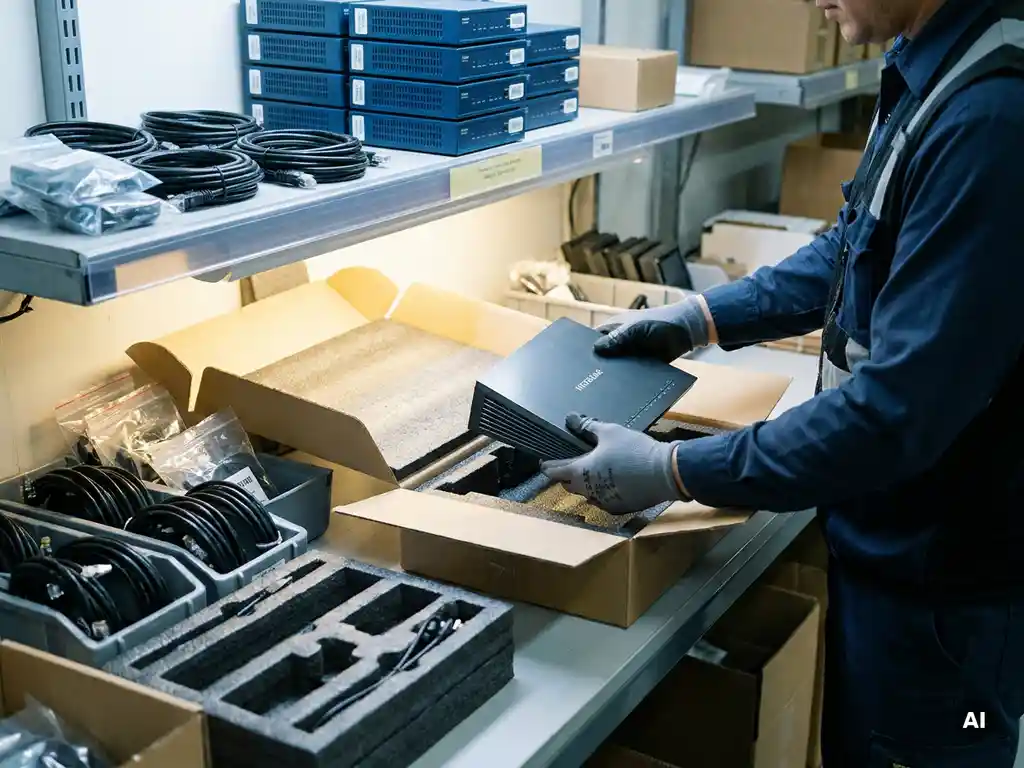
Internet service providers need customised packaging and device kitting because deploying customer premises equipment at scale demands consistency, speed, and accuracy that generic packaging cannot deliver. When a router, modem, or set-top box arrives at a customer’s door incomplete or incorrectly labelled, the resulting support calls and returns create costs that quickly outpace any savings made during fulfilment. The questions below unpack each dimension of this challenge in practical terms.
What does customised packaging actually include for ISPs?
Customised packaging for ISPs goes well beyond printing a logo on a box. It refers to the complete preparation of a device shipment to match the ISP’s brand, the customer’s service tier, and the regulatory requirements of the market being served. This includes branded outer cartons, pre-printed quick-start guides, co-packed accessories, tamper-evident seals, and carrier-specific labelling, all assembled to a defined specification before the parcel leaves the warehouse.
In practice, the scope of customised packaging typically covers:
- Branded boxes and inserts tailored to the ISP’s visual identity
- Pre-packed accessories such as power adapters, cables, and filters specific to the product or region
- Printed documentation including installation guides, regulatory compliance inserts, and welcome letters
- Carrier and address labelling aligned with the outbound logistics provider
- Serial number or IMEI labelling on the outer carton for tracking purposes
The result is a shipment that arrives looking and functioning as if it came directly from the ISP itself, regardless of where the fulfilment actually took place. For large telecom operators managing hundreds of thousands of subscriber activations annually, this level of control over the unboxing experience is not cosmetic; it directly affects first-call resolution rates and customer satisfaction scores.
What is device kitting and how does it work in telecom logistics?
Device kitting is the process of grouping individual components (a router, a power supply, a patch cable, a SIM card, or a set-top box remote) into a single, ready-to-ship bundle that contains everything a customer needs to activate their service. In telecom logistics, kitting typically happens at the fulfilment warehouse before outbound shipment, allowing the ISP to distribute pre-assembled kits rather than managing each component separately.
The process works in a structured sequence. Components arrive at the warehouse individually and are received, inspected, and registered into inventory. A kitting instruction, sometimes called a bill of materials, defines exactly which items belong together for a given product or service tier. Warehouse operatives then pick each component according to that specification, assemble the kit, apply the appropriate packaging and labelling, and move the finished bundle into outbound stock ready for dispatch.
What makes kitting particularly valuable in telecom environments is the combination with serialised inventory management. Each device in the kit, especially the primary CPE unit, carries a unique serial number. Recording which serial number was packed into which shipment, destined for which subscriber, creates a traceable chain that supports provisioning, troubleshooting, and returns processing later in the product lifecycle. Without that link, diagnosing a field fault or processing a return becomes significantly more complicated.
Why does inconsistent packaging cause problems for ISP deployments?
Inconsistent packaging creates deployment problems because it introduces variability at the exact point where standardisation matters most. When kits arrive at subscriber addresses with missing components, incorrect accessories, or wrong documentation, customers cannot self-install successfully, which drives inbound support calls, engineer dispatches, and return shipments that are entirely avoidable.
The downstream effects compound quickly. A missing cable or an incorrect power adapter does not just inconvenience one customer; it generates a return, a replacement shipment, a second delivery attempt, and a support interaction, each carrying its own cost. Across a deployment of tens of thousands of units, even a small error rate in packaging produces a measurable operational burden.
Inconsistency also creates problems for field technicians. When installation teams cannot rely on a kit containing exactly what the specification requires, they begin carrying buffer stock to compensate, which adds cost and reduces accountability. Standardised, verified kitting removes that uncertainty and allows field operations to run more efficiently.
There is a less obvious risk as well: regulatory and brand compliance. ISPs operating across multiple markets must include country-specific safety documentation and adapter types. If packaging is not controlled at the component level, the wrong insert or plug type can end up in a shipment, creating both a customer experience problem and a potential compliance issue.
How does kitting reduce costs in large-scale CPE distribution?
Kitting reduces costs in large-scale CPE distribution primarily by consolidating multiple handling steps into a single controlled process, reducing the number of times a product is touched between manufacturer and subscriber. Rather than picking, packing, and shipping each component separately, a kitted bundle travels as one unit, cutting packaging material, reducing shipping weight, and simplifying outbound logistics administration.
The cost benefits emerge across several areas:
- Reduced returns: Pre-verified kits with confirmed contents lower the rate of incomplete deliveries, which are among the most expensive fulfilment errors to resolve.
- Lower support costs: Customers who receive a complete, clearly documented kit are more likely to self-install successfully, reducing inbound support volume.
- Fewer engineer dispatches: Correct equipment arriving the first time eliminates a proportion of unnecessary field visits caused by missing or incompatible components.
- Inventory efficiency: Kitting at the warehouse allows ISPs to hold components in bulk and assemble to order, reducing the need to pre-build and store finished kits speculatively.
- Simplified billing and reporting: Treating a kit as a single SKU simplifies order management, invoicing, and inventory reconciliation compared to tracking every individual component through the supply chain separately.
These savings depend on the specific operation, the volume of deployments, and how well the kitting process is integrated with the wider fulfilment operation. The efficiency gains are most pronounced when kitting is embedded into an existing logistics workflow rather than managed as a separate, disconnected activity.
What should ISPs look for in a kitting and packaging partner?
ISPs should look for a kitting and packaging partner that combines serialised product tracking, configurable assembly processes, and direct integration with outbound logistics, rather than a general-purpose packing facility that treats telecom hardware like any other consumer product. The ability to handle device-level traceability is the most important technical requirement, followed by the flexibility to accommodate multiple kit configurations across different service tiers or markets.
Key criteria worth evaluating include:
- Serialised inventory capability: The partner should register and track individual device serial numbers throughout the kitting process, not just at goods receipt.
- Configurable bill of materials: Different subscriber segments or geographic markets often require different kit compositions. The partner must be able to manage multiple specifications simultaneously without errors.
- Technical preparation services: Some ISPs require devices to be pre-configured with firmware or configuration files before packaging. A partner that offers device configuration services alongside kitting reduces the number of handoffs in the process.
- Returns integration: Kitting partners should also be capable of processing returned CPE, inspecting it, and determining whether it can be reintegrated into available inventory, connecting fulfilment with reverse logistics in a single operation.
- Quality control processes: Verified kit contents at the point of assembly, not just at goods receipt, prevent the errors that generate downstream costs.
- Scalability: Deployment volumes fluctuate. A partner should be able to handle both steady-state volumes and peak demand without compromising accuracy or lead times.
How BNS Data Logistics supports ISP kitting and packaging
BNS Data Logistics works with telecommunications operators and internet service providers to manage the complete kitting, packaging, and distribution process for customer premises equipment. Our approach combines value-added logistics services with serialised inventory management and technical preparation, creating a single coordinated workflow rather than a chain of disconnected handoffs.
- Customised kitting and co-packing: We assemble kits to ISP-defined specifications, including branded packaging, accessory co-packing, printed documentation, and carrier labelling, tailored to product type, service tier, or destination market.
- Serial number tracking: Using our Cosmos warehouse management system, we register and track individual device serial numbers throughout the kitting process, providing full traceability from goods receipt to outbound shipment.
- Device configuration and firmware preparation: Where required, our technical team can pre-configure devices with the appropriate firmware or configuration files before packaging, reducing the steps between warehouse and subscriber installation.
- Returns and refurbishment: We manage returned CPE through inspection, diagnostics, and, where the product condition allows, refurbishment and reintegration into available inventory, supporting both cost recovery and sustainability objectives.
- Scalable fulfilment infrastructure: Our warehouse operations are designed to accommodate fluctuating deployment volumes, allowing ISPs to scale kitting activity without building internal capacity.
If you are evaluating kitting and packaging options for your CPE deployment or looking for a logistics partner that understands the specific demands of telecom equipment fulfilment, contact BNS Data Logistics to discuss your requirements.
Gerelateerde artikelen
- How can businesses track which electronic devices were delivered to each customer?
- How does IT equipment fulfilment differ from standard B2B fulfilment?
- How does serialized inventory management improve supply chain visibility?
- How can technology manufacturers outsource warehousing and order fulfilment in Europe?
- How can internet service providers manage thousands of customer-owned devices?