
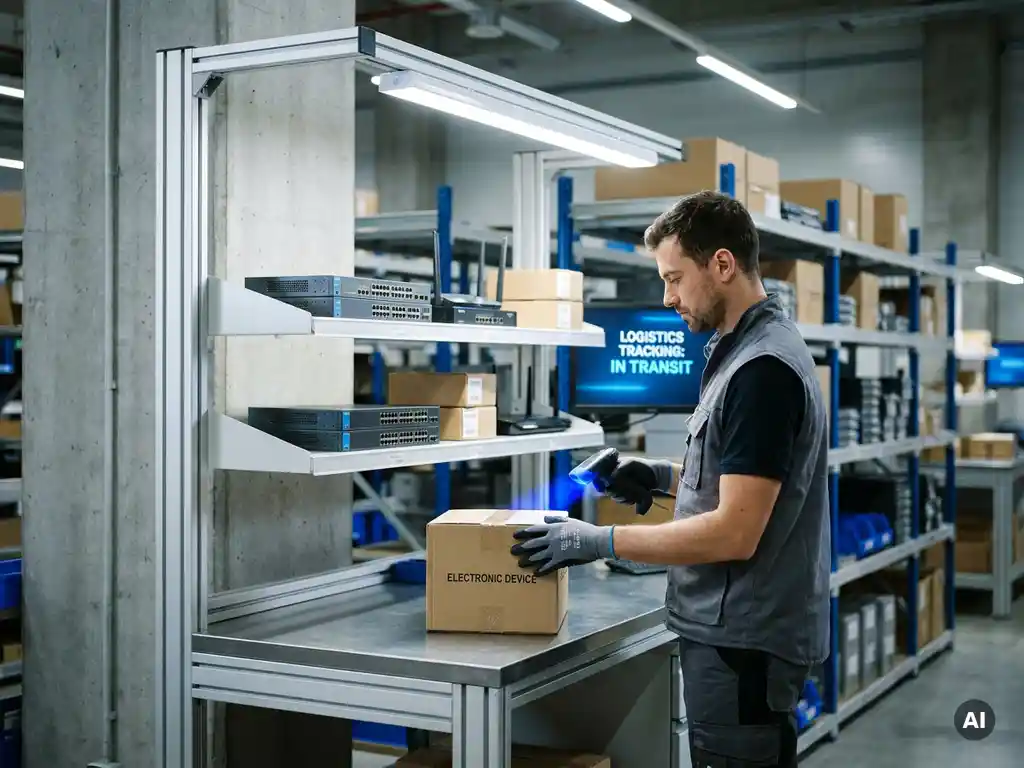
Businesses can track which electronic device was delivered to which customer by recording each device’s unique serial number at the point of despatch and linking it to the corresponding customer order in a warehouse management system. This creates a permanent, auditable record that connects a specific physical unit to a specific delivery. The sections below explain how this works in practice, what data businesses should expect from their logistics partners, and when device-level tracking becomes a compliance requirement.
What methods are used to track individual electronic devices through a supply chain?
Individual electronic devices are tracked through a supply chain using serial number registration, barcode and QR-code scanning, and warehouse management systems that record each product’s movement from receipt to despatch. Every time a device changes location or status, it is scanned and the event is logged against its unique identifier, creating a full audit trail from inbound delivery to final customer shipment.
The most common tracking methods used in technology logistics include:
- Serial number registration: Each device is assigned a manufacturer serial number that serves as its unique identity throughout the supply chain. This number is recorded at goods receipt and referenced at every subsequent handling stage.
- Barcode and QR-code scanning: Labels attached to products or packaging are scanned at key points such as goods-in, storage location, picking, and despatch. This captures movement data without manual data entry.
- Warehouse management system (WMS) logging: A WMS records each scan event against the product’s identifier, building a timestamped history of where the device has been and what has been done to it.
- IMEI and MAC address tracking: For telecommunications equipment such as routers, modems, and mobile devices, additional identifiers like IMEI or MAC addresses are often captured alongside the serial number to support network registration and configuration management.
Together, these methods ensure that every device in a technology fulfilment operation can be located, identified, and traced at any point in its journey.
What is serialised inventory management and how does it differ from standard inventory tracking?
Serialised inventory management is a stock control method in which every individual unit is tracked by its unique serial number rather than managed as part of an anonymous batch or quantity count. Unlike standard inventory tracking, which records how many units of a product are in stock, serialised tracking records which specific units are in stock, where they are, and what has happened to each one.
In standard inventory tracking, a warehouse might record that 200 routers of a particular model are available. The system knows the quantity, but it cannot tell you which specific router was picked for a particular order, or whether a specific unit has already been returned and refurbished. This is adequate for many commodity goods but creates significant gaps for technology products.
Serialised inventory management closes those gaps. When a device is received, its serial number is scanned and registered in the warehouse management system. From that point forward, every action taken on that unit, including storage, configuration, picking, packing, and despatch, is recorded against its serial number. The result is a complete, device-level history that can answer questions such as which customer received this modem, when it was despatched, whether it has been returned, and what was done to it before it was shipped.
For businesses involved in IT equipment fulfilment, telecom hardware deployment, or healthcare technology distribution, serialised inventory management is not optional. It is the foundation of accurate delivery records, effective returns processing, and regulatory compliance.
How does a 3PL link a specific device to a specific customer delivery?
A third-party logistics provider (3PL) links a specific device to a specific customer delivery by scanning the device’s serial number during the picking and packing process and recording it against the corresponding customer order in the warehouse management system. This creates a direct, timestamped association between the physical unit and the despatch record before the parcel leaves the warehouse.
The process typically works as follows:
- Order receipt: A customer order is received and assigned a unique order reference in the WMS.
- Picking: A warehouse operative locates the correct product in storage. For serialised items, the WMS directs the picker to a specific unit or requires them to scan the unit they select.
- Serial number capture: The device’s serial number is scanned at the point of picking or packing. The WMS records this number against the order reference.
- Packing and labelling: The order is packed and a shipping label is generated. The carrier tracking number is also linked to the same order record.
- Despatch confirmation: When the parcel is handed to the carrier, the despatch is confirmed in the WMS. The record now contains the customer name, delivery address, order reference, serial number, and carrier tracking number in a single linked entry.
This chain of data means that if a device needs to be recalled, replaced, or investigated, the 3PL can identify within seconds exactly which customer received which unit and when it was despatched. Value-added logistics services such as device configuration or firmware updates can also be recorded against the serial number at the same stage, so the full preparation history travels with the delivery record.
What data should businesses receive to prove which device was delivered to which customer?
Businesses should receive a despatch record for each order that includes the customer’s name and delivery address, the order reference, the product description, the device’s serial number, the despatch date and time, and the carrier tracking number. Together, these data points constitute verifiable proof of delivery at the individual device level.
Depending on the nature of the product and the industry, additional data may also be relevant:
- IMEI or MAC address: For telecommunications devices, these identifiers support network registration and warranty management.
- Firmware version or configuration profile: If technical preparation was performed before despatch, a record of the software version or configuration applied to the device should be included.
- Condition grade: For refurbished or returned equipment, a condition assessment linked to the serial number provides transparency about the state of the unit at the time of delivery.
- Proof of despatch or carrier receipt: A carrier scan confirmation or consignment note adds a further layer of evidence that the device left the warehouse.
Businesses should expect this data to be accessible through reporting exports, API integrations, or a client portal provided by their logistics partner. Real-time visibility into despatch records, rather than end-of-day batch reports, is increasingly the standard expectation in B2B fulfilment services, particularly for high-value or regulated technology products.
When does device-level tracking become critical for compliance or liability?
Device-level tracking becomes critical for compliance or liability whenever a business needs to demonstrate, with documented evidence, that a specific unit was delivered to a specific recipient. This requirement arises most commonly in telecommunications equipment deployment, healthcare technology distribution, product recalls, warranty management, and regulated electronics markets.
Several situations make serial number tracking not just useful but essential:
- Telecommunications hardware deployment: Operators deploying routers, modems, or set-top boxes to customers need to know exactly which device is installed at which address. This supports fault diagnosis, remote configuration, and equipment retrieval during reverse logistics operations.
- Healthcare technology and medical equipment: Suppliers of AED devices, monitoring equipment, or electronic healthcare products are often required to maintain traceability records as part of product safety obligations. Without device-level records, demonstrating compliance during an audit becomes difficult.
- Product recalls: If a manufacturer issues a recall for a specific batch of devices, serialised delivery records allow the business to identify which customers received affected units and contact them directly, rather than issuing a broad recall across an entire customer base.
- Warranty and support claims: When a customer submits a warranty claim, the business needs to verify that the device in question was genuinely sold and delivered to that customer. A serial number linked to a despatch record provides that verification quickly.
- Refurbished or remanufactured equipment: Businesses selling or deploying refurbished devices need records that distinguish between original units and restored ones, and that confirm which refurbishment steps were completed before despatch.
In each of these scenarios, the absence of device-level tracking creates operational risk. Without it, businesses cannot respond efficiently to recalls, cannot resolve warranty disputes with confidence, and cannot satisfy auditors or regulators who require documented proof of delivery.
How BNS Data Logistics supports device-level tracking and serialised fulfilment
BNS Data Logistics provides serialised inventory management and device-level tracking as a core part of its technology fulfilment operations. For businesses deploying or distributing electronic equipment, this means every device that passes through the BNS warehouse is registered, tracked, and linked to a specific customer delivery.
- Serial number registration at goods receipt: Every inbound device is scanned and registered in Cosmos, BNS’s proprietary warehouse management and product information system, creating an individual record from the moment it enters the warehouse.
- Device-to-order linking at despatch: During picking and packing, each device’s serial number is captured and linked to the corresponding customer order, producing a verifiable despatch record that connects a specific unit to a specific recipient.
- Technical services integrated into the fulfilment workflow: Where devices require configuration, firmware updates, or assembly before despatch, BNS’s technical services are recorded against the serial number, so the preparation history is part of the delivery record.
- Returns and reverse logistics with serialised visibility: When equipment is returned, BNS tracks it back to its original serial number record, supporting warranty management, refurbishment decisions, and inventory reintegration.
- Reporting and operational visibility: Clients receive access to despatch data and inventory information through Cosmos, enabling them to answer questions about specific deliveries without relying on manual records.
If your business needs reliable, device-level tracking across your fulfilment or distribution operations, contact BNS Data Logistics to discuss how we can support your requirements.
Gerelateerde artikelen
- How can serialized fulfilment support product recalls and warranty management?
- What are the main challenges of warehousing electronic devices?
- How can technology manufacturers outsource warehousing and order fulfilment in Europe?
- Why is specialized fulfilment important for high-value electronic equipment?
- What are the benefits of outsourcing IT equipment fulfilment?